

Nature Retreat: "Activating Spiritual Power & Primordial Trust" in the Bavarian Alps
Berchtesgaden, Germany
$1,127 / 4 Days
5.0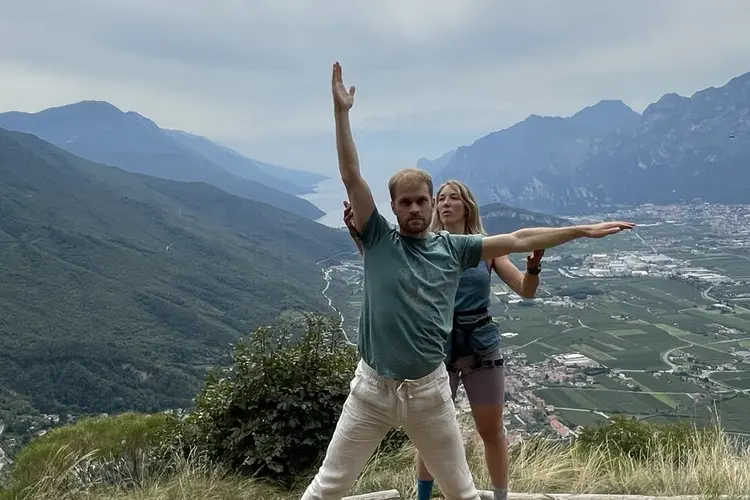
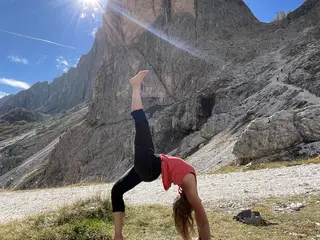
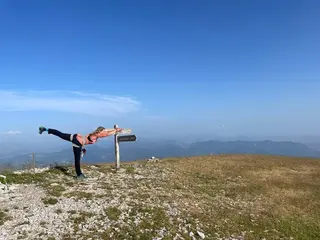
Indria is the Sanskrit term (ancient Indian) for all human senses, which can be either open or closed. The open and alert senses, when connected to a thought, bring a subtle joy to the soul.
“It is not only subjective achievement that gives a person an experience, but rather the alertness of the senses that brings contentment and a lasting memory of the activity.” (adapted from: “Climbing Tours in the Sarca Valley,” Heinz Grill)
During these weekends, we explore the concrete training of consciousness through various activities such as yoga, climbing, or hiking. By engaging concretely with sensory perception, we can learn to expand our own consciousness. Through this practice, combined with concrete philosophical reflections, we can achieve psychological stability, build confidence in our own abilities, and gain a hopeful perspective on our own way of life.
Dates:
>>>2026:
Weekend: February 27 – March 1, 2026 in Italy / Sarca Valley
Weekend: April 17–19, 2026 in Italy / Sarcatal
Weekend: April 24–26, 2026 in Italy / Sarcatal
Monday–Wednesday, April 27–29, 2026
Schedule (Example):
Arrival and getting to know each other on Friday evening in the beautiful Sarca Valley, near Arco by Lake Garda + first yoga session
Start of the day: We begin with an ice bath in a nearby river (for those who wish) and a morning yoga session. Then we choose a theme to guide us throughout the day and through which we aim to make progress. For example: How does the feeling of “the right balance” manifest itself? When is a person in a state of exertion, and when in retreat or passivity? How can a healthy resilience develop that enables healing and an increase in strength?
During the day, we will engage in various activities while staying true to the theme: Options include: climbing (multi-pitch, sport climbing); hiking; via ferrata; swimming in nearby Lake Cavedine; cycling; table tennis in Lundo, … we’ll discuss whether to split up or tackle a goal together—for example, it’s possible that one group climbs a route while we meet at the summit
In the evening, we’ll prepare a meal together or go out to eat
Winding down: A short yoga session, reflection on the day, and setting goals for the next day round out the day and immediately provide a perspective for the next day
The most important facts in a nutshell:
yoga classes
Support and Coaching
climbing
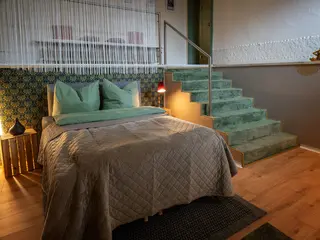
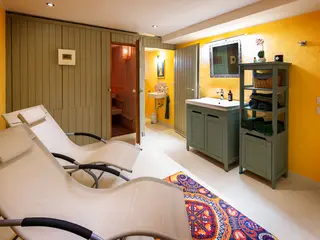
Accommodation available upon request
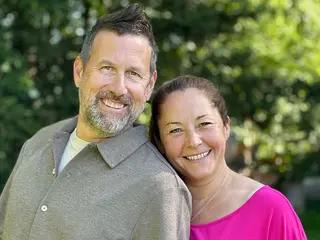
In the Sarca Valley near Arco, in northern Italy, almost right on Lake Cavedine at “Casa Cavedine,” there are simple rooms for visitors set within an impressive architectural setting—managed by Michael, who is also a climber, yoga instructor, master carpenter, and staff member at the Free University of Spirituality in Lundo.
In the beautiful Sarca Valley on the other side of Monte Casale lies the yoga studio at Lake Cavedine—a small-scale semi-detached house that has been artistically designed both inside and out. Nestled among vineyards and apple orchards, the house enjoys a peaceful location right on Lake Cavedine. The living area is on the ground floor, and a large yoga room is on the first floor. Bright colors, numerous rounded arches, and glass doors define the character of the interior spaces. The garden has been artistically designed with stone columns and arches.
Schedule (Example):
Arrival and getting to know each other on Friday evening in the beautiful Sarca Valley, near Arco on Lake Garda + first yoga session
Start of the day: We begin with an ice bath in a nearby river (for those who wish) and a morning yoga session. Then we choose a theme to guide us throughout the day and in which we aim to make progress. For example: How does the feeling of “the right balance” manifest itself? When is a person in a state of exertion, and when in retreat or passivity? How can a healthy resilience develop that enables healing and an increase in strength?
During the day, we will engage in various activities while staying true to the theme: Options include: climbing (multi-pitch, sport climbing); hiking; via ferrata; swimming in nearby Lake Cavedine; cycling; table tennis in Lundo, … we’ll discuss whether to split up or tackle a goal together—for example, it’s possible that one group climbs a route while we meet at the summit
In the evening, we’ll prepare a meal together or go out to eat
Winding down: A short yoga session, reflection on the day, and setting goals for the next day round out the day and immediately provide a perspective for the next day
Mindfulness in Climbing and Yoga
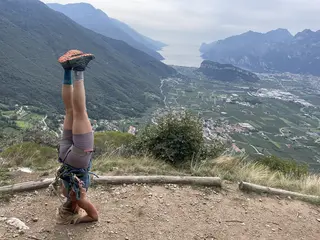
I first noticed the parallels between yoga and climbing a few years ago, when, out of nowhere and without any warning, one of my legs started to shake while I was on a climbing route. It shook and shook, taking on a life of its own, so that my foot seemed on the verge of slipping off the rock. My hands became sweaty, my breathing became shallow, and my entire body tensed up. My entire focus was narrow, very, very narrow, and solely on the physical problem of the “sewing machine.” These fears exist in yoga as well—in a headstand, the immediate concern is not falling over. Or at the sight of an advanced backbend, the thought shoots in: “I’ll never be able to do that!”
Is it helpful to dwell on these fears? Where do these fears come from in the first place?
Both in yoga practice and in climbing, I have realized how, through focused mental guidance and a concrete reference point, entirely new, boundary-pushing, healthy developments are possible. In this process, the fear or the physical limit does not need to be completely ignored; rather, it loses its dominance and can be placed in its proper context through a concrete thought. The physical limit is also not “broken” or forced through with brute strength—a healthy balance emerges. Only through this learned approach can a person move more and more freely and unfold their creative potential. The human being is understood as a spiritually gifted being with a deep-seated desire within the soul for development, maturation, and the unfolding of one’s innermost self-power and the associated powers of the soul.
Climbing and Yoga – Basic Posture
Whether yoga is understood as a stretching exercise or as a philosophy of life is up to each individual. In the sport of climbing, the physical benefits and enrichment provided by yoga postures are already widely recognized. In the “new yoga philosophy,” I have discovered a profound orientation that, through long-term engagement, can permanently transform one’s perspective on life in all areas. It is not a method that stops at physical practice, but rather cultivates a fundamental attitude toward life that then manifests in all areas of life, actions, and in a person’s authentic presence.
Specifically, this means:
The individual sees themselves as an active creator who is not dependent on internal and external influences and circumstances.
The individual grants themselves the opportunity—and even the duty—to strive for an ideal goal, to work toward it, and to train themselves.
The individual continuously strives to build vitality and improve circumstances. In practice, this is the case, for example, when, on the one hand, a beautiful physical form is expressed in an asana, and at the same time, while climbing, a route is left in a better, safer, and more accessible condition. For many years, I have been part of the volunteer team in the Sarca Valley that ensures the safety and preservation of existing and newly developed routes. Inspired by this fundamental attitude, a very concrete application of the yoga philosophy is also found in “private” climbing.

Berchtesgaden, Germany
$1,127 / 4 Days
5.0
Delbrück, Germany
$2,505 / 4 Days
Rösrath, Germany
$797 / 3 Days
Göhren, Germany
$1,127 / 5 Days
$340 / 3 Days