
Table of Contents
- What a couples yoga retreat actually is (and what it isn't)
- Partner yoga: what it is and why it changes the dynamic
- Which yoga style works best when you're practicing together
- What a typical day looks like
- How to choose: five questions before you book
- Where couples go: settings and destinations
- Frequently asked questions
- What is a couples yoga retreat?
- Do we need yoga experience to attend a couples yoga retreat?
- What is partner yoga and is it part of every couples retreat?
- How much does a couples yoga retreat cost in 2026?
- How do we choose between a couples yoga retreat and a couples healing retreat?
- Are couples yoga retreats good for beginners?
- Are couples yoga retreats romantic?
- How long should a couples yoga retreat be?
- Plan your retreat together
The first time you try to hold a partner balance, it collapses. Both of you laugh. The second attempt lasts maybe three breaths before one of you shifts weight the wrong way. On the third try, something clicks: you stop thinking about the pose and start actually paying attention to the other person. Four breaths. Five. The instructor says nothing.
That moment is what couples yoga retreats are built to create. Not the balance itself. The paying-attention part.
This guide is for couples who have already decided on a retreat and are now asking the more useful questions: what kind of yoga works best when you're practicing together, what to look for when comparing programs, and what a week actually feels like once you arrive. For an overview of what a yoga retreat involves generally, that article covers the basics. For couples in a more difficult chapter who need therapeutic support, couples healing retreats are a distinct category with different requirements.
What a couples yoga retreat actually is (and what it isn't)
A couples yoga retreat is a residential program built around shared yoga practice. That definition covers a wide range of formats, and the difference matters before you book.
On one end: two people attending a standard yoga retreat together, sharing a room and a schedule. No couples-specific programming, no partner exercises, no communication workshops. You practice alongside each other; the coupling is logistical and romantic rather than structural.
On the other end: programs that design every element around the pair. Partner yoga as the core morning practice. Communication or breathwork workshops aimed specifically at couples. Daily structure built around practicing together rather than in parallel.
Both formats are legitimate. They produce different experiences. If you want built-in partner practice, ask the program directly what percentage of the daily schedule is couples-structured versus individual. If their "couples yoga retreat" is a general yoga retreat with "couples welcome" marketing, that is useful to know before you arrive.
What a couples yoga retreat is not: couples therapy, a spa weekend, or a substitute for genuine relationship repair. If the primary goal is to address significant relationship distress, a couples healing retreat with licensed practitioners is the right format. A yoga retreat is for couples who are fundamentally okay and want a shared reset, a deeper physical connection, or a travel experience with more substance than the average weekend away. The two are different products; using the wrong one wastes both time and money.
Partner yoga: what it is and why it changes the dynamic
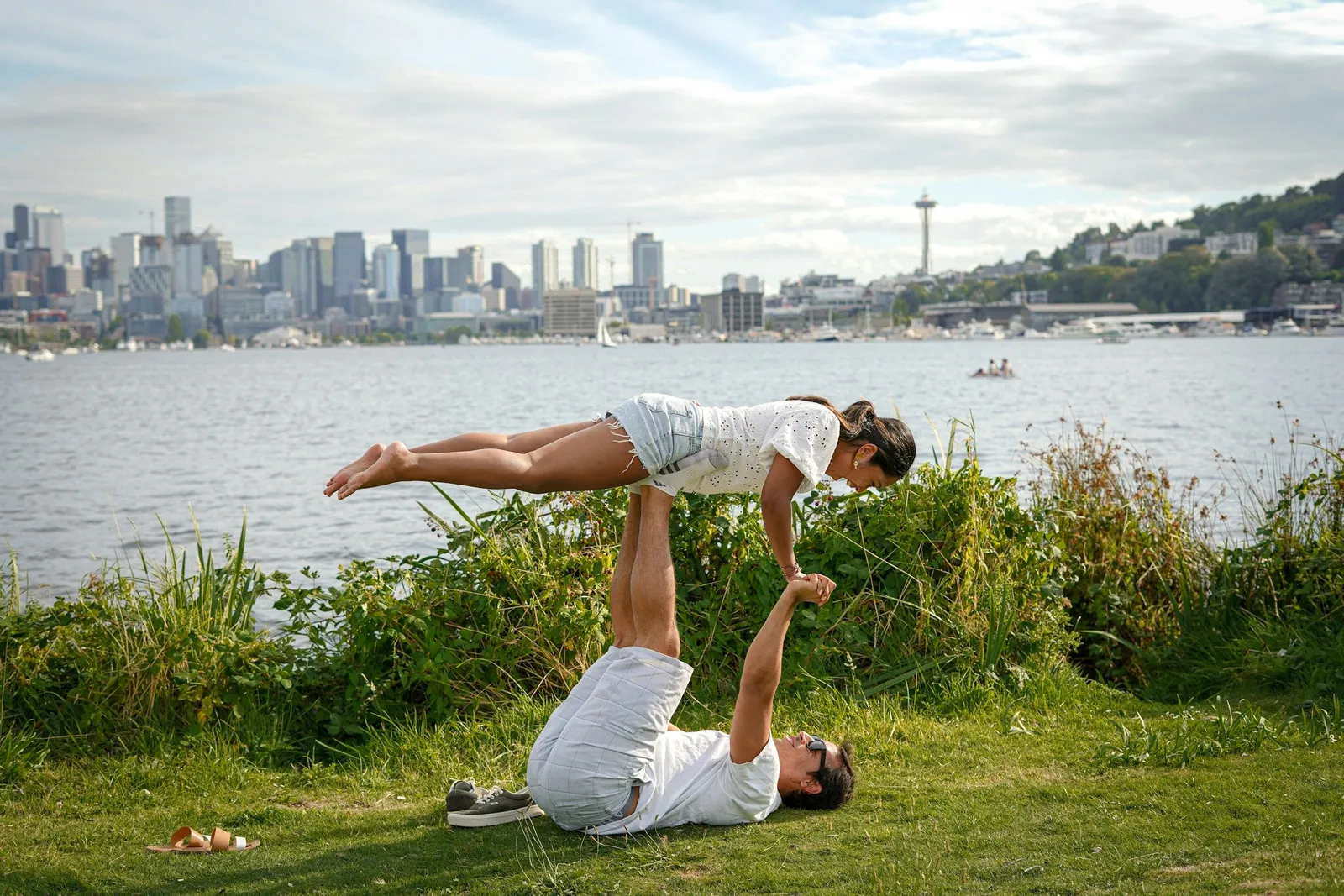
Partner yoga uses two people's weight and counterbalance to create poses that neither could sustain alone. The most visible form is acroyoga: one person becomes the base (lying on their back, feet in the air), the other flies. But partner yoga also includes simpler forms, seated back-to-back twists, supported forward folds where one person holds the other into a stretch, mirrored flows where both people move through the same sequence with hands in contact.
The reason it changes relational texture is mechanical. You cannot fake the communication. A partner balance requires you to tell the other person what you feel in real time. "Too heavy on the right." "I'm about to come down." "More weight." You are physically co-regulating, adjusting for each other's breath and weight shifts moment by moment. The quality of your attention to the other person shows up immediately in whether the pose holds.
This is entirely different from practicing yoga on adjacent mats. Side-by-side practice is parallel play. Partner yoga is collaborative. The feedback loop is immediate and physical rather than social or verbal.
The relational effect is not mystical. It is the ordinary result of doing something unfamiliar together, relying on each other not to drop anyone, and spending several hours a day in physical contact while focused on something other than your screens. Most couples describe the experience as unexpectedly honest rather than romantically scripted.
Which yoga style works best when you're practicing together
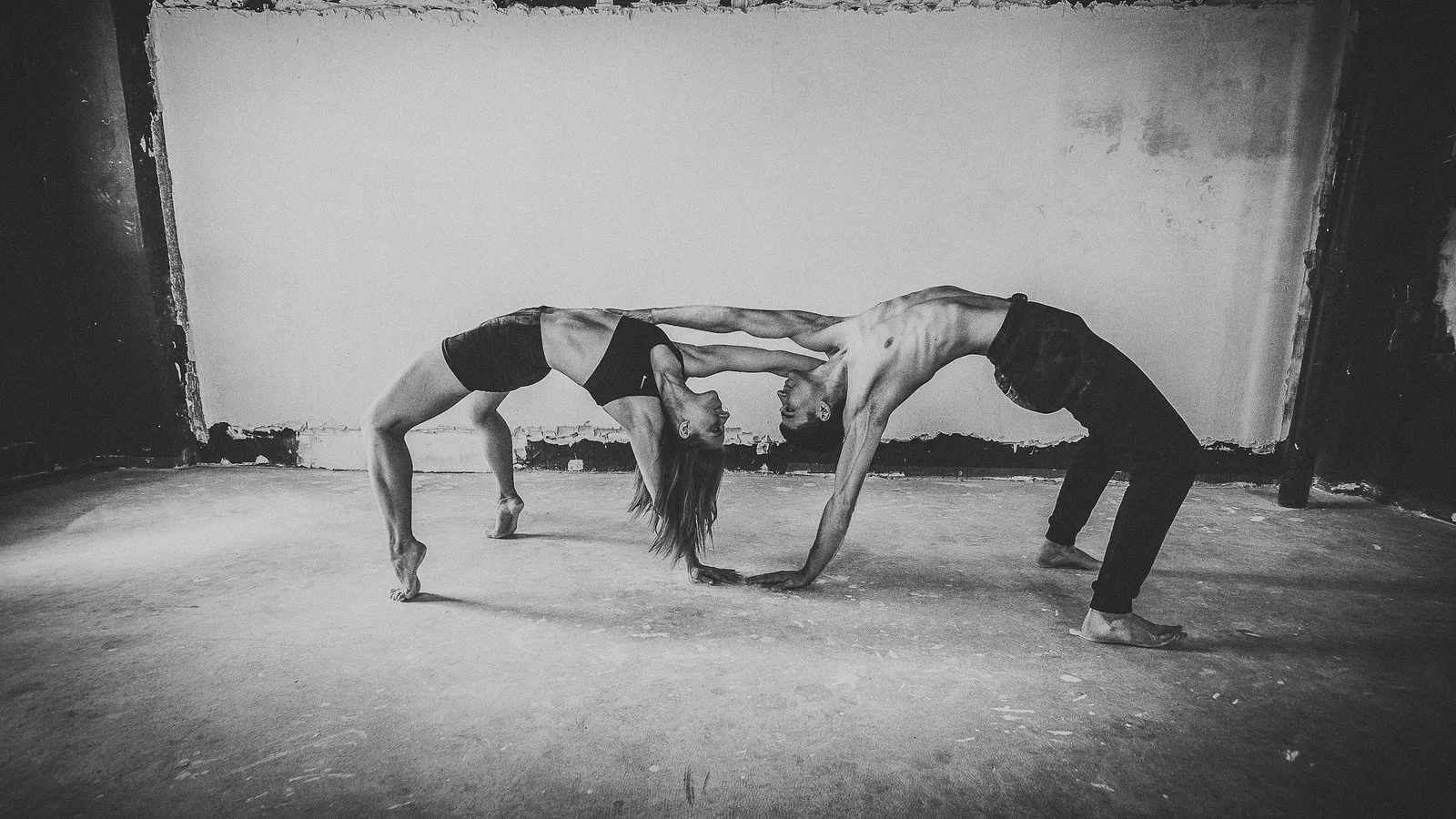
Style selection is the practical question no destination listicle covers. It matters more when two people are on the same mat.
Hatha. Slow, individually-paced, with clear verbal instruction between poses. Good for couples with mismatched experience levels, because the pace gives the less experienced person space to catch up without pressure. Natural windows between poses let couples check in with each other. A reliable default for first-time couples retreats.
Yin. Long holds, three to five minutes per pose, in a quiet room. Physically and emotionally opening in a way that surprises most people. Extended time in each pose creates space for thoughts to surface and pass. Couples often find these sessions unexpectedly intimate: the pace allows genuine presence rather than movement-chasing. One caveat: physical intensity can be high if either person carries significant tension in the hips or lower back; mention this to the instructor before class.
Acroyoga. Playful, active, built entirely around the pair. Higher physical demands and a real learning curve. Best for couples where both have some yoga foundation and neither is carrying injuries that restrict load-bearing or inversion. The laughter quotient is high; so is the vulnerability when a fly fails three times and you work out how to try again.
Vinyasa. Flow-based, breath-linked movement. Excellent when levels are matched. Can create friction when one person is significantly further along than the other, because the pace leaves little time to work out a modification before the class has moved on. Worth asking the program whether their vinyasa sessions assume a shared baseline.
Styles to approach carefully as a couple: Bikram or hot yoga (heat creates individual physical stress, which tends to draw attention inward rather than toward the other person); and Kundalini in its more intense or esoteric forms (the framework can feel alienating to a skeptical partner, producing tension rather than connection if the context doesn't suit both).
What a typical day looks like
Here is how a well-run couples program structures the day.
7:00. Morning practice, sixty to seventy-five minutes. Hatha or Vinyasa, sometimes with a partner section woven in. No phones in the room.
8:30. Communal breakfast. Plant-forward food, shared table. The morning meal is underrated in the program design: eating with the people you practice with creates a social warmth that solo travel rarely does.
10:00. Free time or an optional workshop. Couples-specific workshops typically land here: breathwork for two, communication exercises, shared journaling. Optional means optional; taking the free time to read or swim is also correct on the days you need it.
13:00. Lunch.
15:00. Afternoon session, usually Yin or restorative. Slower, longer holds, physically softer than the morning. Many couples find the afternoon session emotionally richer, because the body has released some held tension and the defenses are lower.
18:00. Guided meditation or pranayama.
20:00. Dinner, then largely unstructured evening.
The thing that surprises most couples: what shifts between you is not the yoga class. It is the sustained absence of split schedules, separate to-do lists, screens, and the operational logistics of shared daily life. The retreat creates the conditions for presence. What you do with that presence is the actual work.
How to choose: five questions before you book
1. Does this retreat have couples-specific programming, or is it two people attending a group retreat? Ask directly. Marketing copy rarely distinguishes. You want to know what percentage of the daily schedule includes partner elements versus side-by-side individual practice.
2. What yoga style or blend does the program offer? Match to your combined level and goal. A strong Ashtanga program is not the right first couples retreat for two people who do occasional home yoga.
3. Are you looking for a wellness reset or genuine relationship repair? If the relationship is under significant stress or in a repair phase, a couples yoga retreat is the wrong tool. A couples healing retreat with licensed facilitators is built for repair; this format is built for reset. If you're not sure which one applies, couples retreats on retreat-vacation.com lets you filter across both categories to compare what is available. Use the right tool for what you actually need.
4. How many participants? Under twenty couples is the sweet spot for programs that offer genuine instructor attention without becoming a large workshop. Very small programs, under six couples, often provide the most personalized experience.
5. What is actually included in the price? All-inclusive pricing, with meals, accommodation, and all sessions in a single fee, almost always works better for a couple than add-on pricing. Every micro-purchase decision during the retreat reintroduces domestic friction that the retreat exists to remove.
For budget-tier options, affordable retreat options covers what the lower price bands actually deliver. For a detailed cost breakdown by yoga format, yoga retreat costs goes deeper on what the numbers mean. Still in exploratory mode? Couples retreat ideas covers the broader category before narrowing to yoga specifically.
Where couples go: settings and destinations
No operator names below. Tier, region, and what makes each work for couples.
Bali (affordable to mid-range, roughly $100 to $300 per person per night all-inclusive). One of the highest concentrations of well-run yoga programs per square kilometer anywhere. Outdoor practice pavilions, tropical setting, year-round warmth. Most programs are couples-welcoming by default with shared-room accommodation built into the price. Strong Hatha and Vinyasa culture. Best for couples who want a week-long immersion at reasonable cost; the long-haul flight is the variable that makes the math work or not.
Portugal and Spain (mid-range, roughly $200 to $400 per person per night). Converted farmhouses and fincas with a strong Yin and slow-yoga culture. European-accessible, visa-free for most readers. Shoulder seasons, spring and autumn, bring good weather and lower pricing. Smaller groups and more privacy than comparable Bali programs.
Mexico and Costa Rica (mid-range, roughly $150 to $350 per person per night). Beach and jungle settings with a growing cluster of couples-specific programming. English is the working language. May through October cuts pricing fifteen to thirty percent with minimal quality trade-off. Beach yoga retreats covers the coastal format in more detail.
US (weekend to week-long, premium tier, roughly $350 to $800 per person per night). Weekend-format dominant, given domestic travel patterns. California coast, Colorado, and Vermont have the deepest couples-friendly retreat inventory. Higher all-inclusive quality, closer to home. Winter yoga retreats covers the off-peak planning angle for US programs.
India (budget, sub-$100 per person per night at ashram programs). Traditional yoga lineage, deep program substance, very affordable. Limited couples-specific programming. Better suited to individually-focused practice than to partner yoga. Best for couples where both have a serious personal yoga practice and want depth over connection-focus.
Frequently asked questions
What is a couples yoga retreat?
A residential program where partners practice yoga together, typically over three to seven days. Most include daily yoga classes, shared meals, and some unstructured time. Couples-specific programs add partner yoga, communication workshops, or breathwork sessions designed for pairs. The format ranges from two people sharing a room at a general yoga retreat to fully-structured couples-only programming.
Do we need yoga experience to attend a couples yoga retreat?
No. Most programs welcome all experience levels. If one person has no yoga background at all, confirm that beginner modifications are built into the main sessions before booking.
What is partner yoga and is it part of every couples retreat?
Partner yoga uses two people's weight and counterbalance to create poses neither could hold alone. Acroyoga is the most recognizable form, though simpler practices like supported forward folds and back-to-back twists are more common in group retreat settings. Not every couples retreat includes structured partner yoga: some are two people attending a group retreat on side-by-side mats. Ask before booking which elements of the program are couples-specific.
How much does a couples yoga retreat cost in 2026?
Three broad tiers. Budget programs in Southeast Asia or Eastern Europe: roughly $100 to $200 per person per night, all-inclusive. Mid-range programs in Europe, Mexico, or Costa Rica: $200 to $400 per person per night. Premium US resort or private programs: $400 to $800 per person per night. Weekend packages start around $400 to $600 total for two at the budget end; full weeks at a well-run mid-range program typically run $1,500 to $3,500 per couple. For the full breakdown, see how much a yoga retreat costs.
How do we choose between a couples yoga retreat and a couples healing retreat?
Stable relationship, shared reset, physical and mental: yoga retreat. Recurring conflict patterns, significant stress, licensed therapeutic support needed: couples healing retreat. The two are different products designed for different situations. Using the wrong one wastes the trip and sometimes makes things worse.
Are couples yoga retreats good for beginners?
Yes, provided you choose the right style. Hatha and Yin welcome first-timers; Acroyoga and Ashtanga programs assume some prior foundation. Confirm the level when you contact the program. For a full guide to first-time yoga retreats, yoga retreats for beginners covers what to expect, what to pack, and how to read the program description before you commit.
Are couples yoga retreats romantic?
Yes, but not in the scripted spa-package sense. The romance is practical: uninterrupted time, shared vulnerability in poses you both find difficult, a daily rhythm stripped of domestic logistics. Most couples describe the experience as unexpectedly honest rather than Hollywood-romantic. That honesty, it turns out, is more sustaining.
How long should a couples yoga retreat be?
A weekend gives you a reset. A full week starts to build a shared rhythm you can carry home. For most couples with some existing yoga practice, three to five days is the sweet spot: long enough to settle into the schedule and benefit from the partner practice, short enough to fit most work calendars. If the goal is learning a specific style or deepening a practice you both already have, a week or longer makes more sense.
Plan your retreat together
That shared week you pictured while reading the destinations section, outdoor practice with warm evenings and no split schedules, is what couples come back from having actually done. Browse over 600 curated yoga retreats at retreat-vacation.com and filter by style (Hatha, Yin, Acroyoga, Vinyasa), destination, duration, and accommodation tier to find programs that match both your schedules and experience levels. Fall 2026 week-long programs at popular Bali and Portugal properties tend to book out by late summer, so filtering by your travel window first saves time.