
Table of Contents
- Why a yoga retreat works differently than a studio class
- Which yoga style is right for your first retreat
- What a day at a beginner yoga retreat looks like
- How to choose a beginner yoga retreat: six questions to ask before you book
- Where in the world beginners go: setting and destination patterns
- What a beginner yoga retreat costs
- How to prepare for your first yoga retreat
- After your first retreat: how to make the gains last
- Frequently asked questions
- Do I need to know yoga before attending a retreat?
- What is a typical day like at a yoga retreat for beginners?
- How long should my first yoga retreat be?
- What yoga style is best for a beginner retreat?
- How much does a beginner yoga retreat cost?
- Should I go to a yoga retreat alone as a beginner?
- What should I pack for my first yoga retreat?
- Plan your first retreat
The instructor delivers the first instruction of the morning without ceremony: "There is no wrong version of this pose." Six words that remove about half the anxiety most beginners carry into the room. That is the structural difference between a yoga retreat and every studio class you have taken before.
This guide is for readers who have practiced yoga a handful of times, or not at all, and are wondering whether a retreat makes sense for someone at that level. The short answer is yes. This is how to find one that fits, avoid the ones that do not, and get the most out of the format once you are there.
Why a yoga retreat works differently than a studio class
A studio class ends the moment you roll up your mat. A retreat does not. The schedule, the food, the people you eat with, and the physical space are all designed to support the practice. There is no commute home, no social performance pressure, no decision fatigue about what to cook or when to sleep.
That removal of friction does more work than the yoga itself in the first 24 hours. Beginners who have struggled to build a home practice report that the residential structure solves a problem they could not solve on their own: the environment does the habit-forming for you.
Group sizes at beginner retreats tend to run smaller than studio classes, which means the instructor can actually see what you are doing. First-time practitioners get corrections and adjustments that would take months to accumulate in a drop-in class.
For a foundational overview of what a yoga retreat involves, what a yoga retreat actually is covers the basics. For a broader look at the wellness retreat category, what a wellness retreat involves is the orientation read.
Which yoga style is right for your first retreat

This is the one piece of information no marketplace listing will tell you. The yoga style matters more at your first retreat than the destination.
Hatha. Slow pace, individual poses held for several breaths, strong focus on alignment. The foundational style. Instructors working with beginner groups almost always teach Hatha because it gives you time to understand what a pose is actually asking of your body. Best first choice.
Yin. Long, passive holds of three to five minutes per pose. Targets connective tissue rather than muscle: slow, sustained stretch loads fascia differently than dynamic movement, a principle supported by fascial connective tissue research. Excellent for people whose bodies are tight from desk work or a sedentary routine. Very manageable for beginners because the pace is slow and stillness is the goal.
Restorative. Props-heavy, therapeutically gentle. Poses are fully supported, held for five minutes or more, designed for nervous system regulation rather than physical challenge. The right choice if you are arriving exhausted rather than merely untrained.
Vinyasa. Flow-based and more aerobically active. Manageable for beginners when the instructor is experienced with mixed-level groups. Requires more body coordination than Hatha at the start. Not a bad first choice, but confirm the class is explicitly labeled beginner or all-levels before booking.
Styles to defer. Ashtanga follows a set sequence that rewards prior practice, and the physical demands can overwhelm someone entirely new to yoga. Bikram and hot yoga add heat and intensity to a beginner experience that is demanding enough at room temperature. Advanced Kundalini programs involve a spiritual and breath-work framework that can feel disorienting without some prior context.
Many beginner retreats blend styles across the week, alternating Hatha morning sessions with Yin afternoons. That is a reasonable structure. Ask the program what the daily schedule actually looks like before you book.
What a day at a beginner yoga retreat looks like
A representative schedule at a beginner-focused residential retreat:
6:30. Gentle wake. Optional, and actually optional.
7:00. Morning yoga session. Sixty to seventy-five minutes, foundational poses, pranayama (breath work). This is the core of the day. Most beginners feel better by 8:30 than they have in a long time, which becomes the best argument for showing up at 7:00 tomorrow.
8:30. Breakfast. Plant-forward, communal, unhurried. The conversation at the breakfast table is where most of the retreat's social bonding happens.
10:00. Workshop, free time, or a nature walk. Formats vary: some retreats run a philosophy session, some a breathwork class, some simply leave this block unstructured.
12:30. Lunch, rest, swimming, reading.
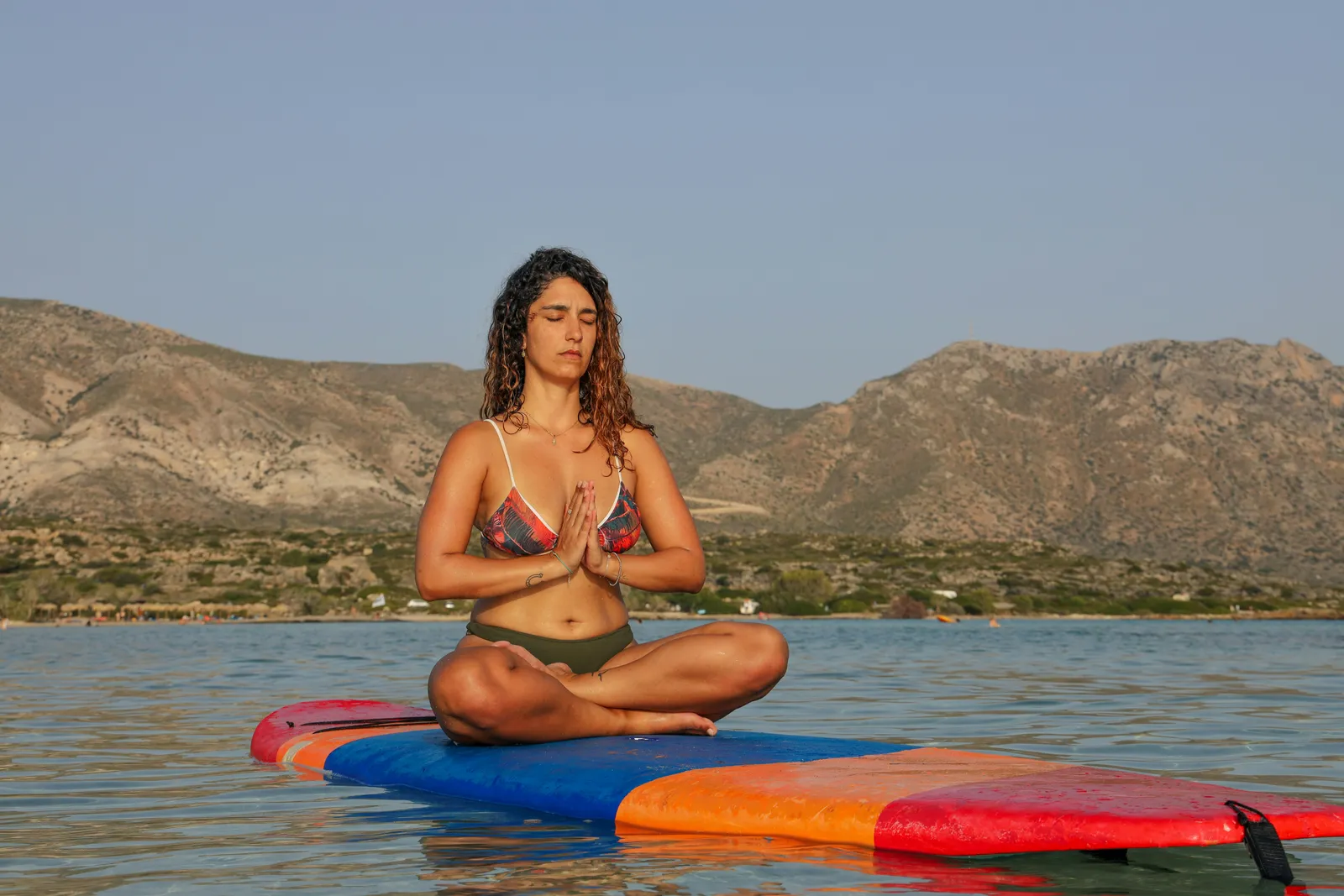
15:00. Afternoon session. Often restorative or Yin, lower intensity than the morning. Sometimes replaced by a workshop on posture mechanics, yoga philosophy, or meditation introduction.
18:00. Meditation or group reflection circle. Fifteen to twenty minutes. Not mandatory at most retreats.
20:00. Wind-down. Herbal tea, slower conversation.
21:00. Sleep.
The absence of a commute, a to-do list, and social media is part of the program. It sounds obvious. The effect in practice is significant enough that most first-time attendees mention it before they mention the yoga.
For a full sample schedule you can benchmark specific programs against, see our yoga retreat itinerary guide.
How to choose a beginner yoga retreat: six questions to ask before you book
1. Is it explicitly beginner-friendly, or just "all levels"? These are not the same thing. "All levels" often means advanced practitioners will not be bored. A beginner-labeled retreat typically means the instructor builds the program from foundational poses up, regardless of what anyone in the room already knows. Ask the organizer directly if you are not sure.
2. What yoga style or blend does the program use? Match the style to your starting point. Hatha or Yin for a genuinely new practitioner. Vinyasa if you have some studio background and want something more energetic. See the styles section above for the full breakdown.
3. How many participants attend? Under fifteen is the sweet spot for beginner personal attention. Larger programs have more social energy but less individual instructor contact. Ask the program specifically.
4. How long is it? A weekend (two to three nights) is the lowest-commitment entry point, a useful gauge of whether the residential format suits you before committing to a full week. Five to seven nights gives enough time to build a daily rhythm and experience the nervous system shift that makes longer retreats different from shorter ones. Most practitioners who have done both say four nights is the practical minimum for that shift to register.
5. What does the daily structure look like? Two led sessions per day plus free time is the standard. Schedules packed with back-to-back workshops from morning to evening are exhausting for beginners. Ask for the actual daily timetable before booking, not just the program description.
6. What is included in the price? Accommodation, all meals, and all yoga sessions should be included at the price you are quoted. Massages, private sessions, and airport transfers are almost universally extra. For the full cost picture, see how much a yoga retreat costs.
Once these six questions are answered, destination becomes the deciding factor. Beach yoga retreats and winter yoga retreats cover the setting-specific options for readers who have a climate or landscape preference. If you are ready to start browsing, retreat-vacation.com/all/c/yoga-retreats lets you filter by style, duration, and location to surface programs that match your criteria.
Where in the world beginners go: setting and destination patterns
No operator names below. What follows is a pattern map by setting and format, not a list of specific programs.
Tropical and beach settings (Southeast Asia, Mexico, Costa Rica). Warm climate extends outdoor practice. Hatha and Vinyasa dominate. Pricing at entry and mid-range tiers: Asia-based programs run full-week packages at $80 to $200 per night including accommodation and meals. Mexico and Costa Rica sit in the mid-range band. The travel cost to Asia is the variable; once you are there, the weeks are inexpensive.
Mountain and forest settings (Austria, Portugal, Italy; Colorado, Vermont). Slower pace, strong nature immersion, typically Yin or Hatha focus. European programs in this category tend to run three to five nights with group sizes of eight to fourteen participants. US mountain programs range from rustic center formats to higher-end ranch properties.
Urban retreat centers (US East and West Coasts). Weekend format, accessible by public transit from major cities, entry-level pricing. The lowest-friction option for a first retreat: arrive Friday evening, leave Sunday afternoon, no international travel required.
Ashram-style programs (India). Deep immersion, traditional teaching lineage, structured day from early morning to evening. The most affordable format globally for a full week including meals. The right choice for readers who want foundational training in yoga's original context, not just the physical practice. Best suited to those comfortable with shared accommodation and a structured daily schedule.
For more on the beach-setting format specifically, beach yoga retreats covers destinations and what to expect from an ocean-adjacent program. For "near me" searches, the category page at retreat-vacation.com/all/c/yoga-retreats filters by country and region so local results surface first.
What a beginner yoga retreat costs
A lightweight overview: the full breakdown lives at how much a yoga retreat costs.
Entry tier ($80 to $200 per night). Asia-based programs, some Caribbean ashrams, some domestic US center formats with shared accommodation. Meals and sessions included.
Mid-range ($150 to $400 per night). Europe and Mexico programs, established US holistic centers, domestic retreat centers with private rooms. The most common tier for a first retreat that balances comfort with reasonable pricing.
Premium ($400 to $1,500 per night and above). Luxury resort-style programs, spa properties with yoga as an integrated offering, boutique operations with high instructor-to-participant ratios. You are paying for amenities and exclusivity more than for the quality of the yoga teaching itself.
What is typically included: accommodation, all meals, all scheduled yoga and meditation sessions, access to grounds and common spaces. What is typically extra: massage and bodywork, private instruction sessions, airport transfers, excursions, and specialty workshops outside the daily schedule.
Budget readers: affordable wellness retreats under $2,500 covers the broader category with practical price-band guidance across formats.
How to prepare for your first yoga retreat
Physically. Start a home practice two to four weeks before you leave. Fifteen minutes a day is enough. The goal is not to get fit before the retreat but to introduce your joints and connective tissue to the range of motion you will be asking of them. Going from zero practice to two sessions per day for seven consecutive days is harder on the body than the program description implies.
Mentally. Write down one thing you want to leave behind at the retreat and one thing you want to take home. Most instructors recommend this before arrival. It functions as a contract with yourself about what the week is actually for.
Packing. Bring more layers than you think you need. Yoga studios and retreat halls are often cool in the early morning. The full packing checklist is at what to pack for a yoga retreat. The short version: a mat (check first if the program provides them), comfortable non-restrictive clothing, a journal, and realistic expectations about what "beginner" looks like in practice.
Finally, the mindset question: you are attending as a beginner, and that is not a problem to overcome before arrival. A beginner retreat is designed around the experience of being genuinely new to something in a supported setting. Arriving with a performance orientation undercuts the format before it has a chance to work.
After your first retreat: how to make the gains last
The failure mode is consistent: you return energized, resume the same schedule, and the practice fades within two weeks. Three steps that change this outcome:
Before you leave the retreat, commit to one practice session per week at home. Pick the specific day and time. Put it in the calendar. Scheduling a behavior during the period of high motivation (which is the last day of a retreat) is more predictive of follow-through than scheduling it after you return.
Find a local studio or online class in the same style you practiced. The style match matters. If your retreat was Yin, a Vinyasa class at your local studio will feel like a different activity. Finding the closest equivalent to what you practiced at the retreat preserves continuity.
Reconnect with at least one retreat participant within 30 days. Social accountability is the strongest predictor of habit continuation after any intensive program. You do not need a group chat or a formal structure. One check-in with one person who was there is often enough.
For readers who chose a retreat for stress or burnout reasons, the integration section in our burnout recovery retreats guide covers post-retreat maintenance with more depth for that specific situation.
Frequently asked questions
Do I need to know yoga before attending a retreat?
No prior experience is required at a beginner-specific retreat. Programs labeled for beginners build the curriculum from foundational poses and breath work, regardless of what participants already know. If you have never practiced yoga at all, that is the most common starting point among first-time retreat attendees, not an exception.
What is a typical day like at a yoga retreat for beginners?
Most beginner retreats run two sessions per day: a morning session of sixty to seventy-five minutes focused on foundational poses and pranayama, and an afternoon session of forty-five to sixty minutes that is often restorative or Yin. Meals are communal and included. Midday typically has free time for rest, walking, or reading. The structure varies by program; ask for the actual daily timetable before booking.
How long should my first yoga retreat be?
A weekend (two to three nights) is the lowest-commitment entry point and a useful test of whether the residential retreat format suits you. Five to seven nights gives enough time to form a daily practice rhythm and experience the nervous system regulation effect that longer stays produce. Four nights is widely reported as the threshold where the deeper shift tends to register for first-time attendees.
What yoga style is best for a beginner retreat?
Hatha is the most beginner-accessible style: slow, alignment-focused, and foundational. Yin is excellent for tight or sedentary bodies. Restorative is the gentlest option, designed for recovery and nervous system regulation. Vinyasa is manageable for beginners with a good instructor but more physically active. Defer Ashtanga, Bikram, and advanced Kundalini until you have a foundation in place.
How much does a beginner yoga retreat cost?
Entry-level programs in Asia run $80 to $200 per night all-inclusive. Mid-range programs in Europe and Mexico sit at $150 to $400 per night. Premium and luxury formats start at $400 per night and above. Most programs at any tier include accommodation, all meals, and all yoga sessions. For the full breakdown by tier and destination, see our yoga retreat cost guide. Budget readers can also look at affordable wellness retreats under $2,500.
Should I go to a yoga retreat alone as a beginner?
Going solo is common and often preferable for a first retreat. Group retreats are social by design, and retreat environments create fast community among strangers with shared goals. Solo travel removes the complication of aligning schedules and preferences with a partner. If you are considering going with a partner, the couples yoga retreat guide covers formats and what the shared-retreat dynamic looks like in practice.
What should I pack for my first yoga retreat?
Confirm whether the program provides yoga mats before packing your own. Core items: comfortable non-restrictive clothing in layers (studios are often cool in the morning), a journal, and realistic expectations of your starting level. The full packing checklist is at what to pack for a yoga retreat.
Plan your first retreat
Browse over 600 curated yoga programs at retreat-vacation.com. The catalogue filters by yoga style, duration, and location, so you can match a program to your specific starting point whether that is a Hatha weekend in the mountains or a week-long Yin immersion by the sea. Beginner-labeled programs are filterable separately from all-levels and advanced formats. Programs for fall and winter 2026 tend to fill two to three months in advance, so searching by your travel window first saves time.