Retreat Urlaub - Urlaubsangebote für Körper, Geist und Seele.

Yoga Retreats in Greece

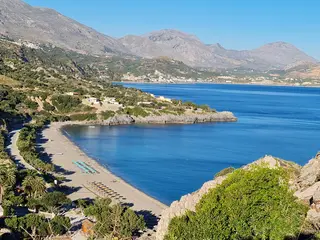
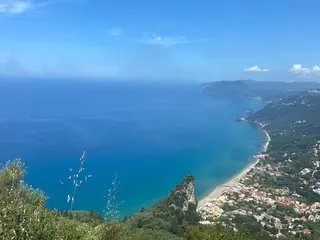
Warm Mediterranean light, ancient olive groves and an island world that shifts between steep cliffs, whitewashed villages and quiet bays — Greece is one of Europe's oldest and at the same time most relaxed yoga destinations. From mainland regions such as the Peloponnese and Chalkidiki to the Ionian islands around Corfu and on to the Cyclades and the long, generous island of Crete, you will find a calm, well-grown retreat landscape, reachable in two to three flight hours.
5 curated retreats from €657

Discover Our Most Popular Offer

View all offers

New retreats straight to your inbox?

So you always stay up to date.

We take data protection very seriously. Further information
Why Greece works as a yoga destination

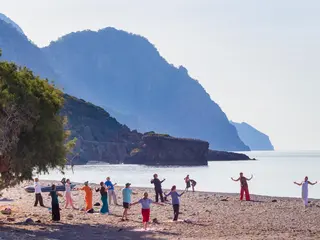
Greece brings together a combination that other European yoga countries rarely match in this density: a remarkably stable Mediterranean climate, a culturally familiar Mediterranean cuisine and a landscape that reinvents itself in almost every region, between the mainland and the islands. The result is a destination where you arrive emotionally after two or three days, without the journey itself draining you. The most obvious advantage is access. Athens, Heraklion on Crete and Corfu have year-round direct flights from Frankfurt, Munich, Vienna, Zurich and many other central European cities. Flight times sit between two and three hours, and most retreat houses organise the transfer from the airport so that you arrive in a quiet setting on the same day you fly. The second strength is the landscape range. If you want mountains and silence, you will find them on the mainland Peloponnese, in the interior of Crete or in the less-visited valleys of Corfu. If you want the sea, you can choose between the soft, green atmosphere of the Ionian coast, the drier elegance of the Cyclades and the long, calm beaches of Chalkidiki. This breadth lets you tune a retreat very precisely to what you actually need — from an immersive nature experience to walking-distance access to the water. The third factor, often underestimated, is the daily rhythm. Greek houses live with the light rather than against it: early morning practice in cool air, long midday breaks and evening yin or restorative sessions under an open sky. This pacing follows the country's summer routine and is one of the reasons many guests return home with a noticeably different sleep and breathing rhythm than the one they came with.
Which island or region fits which kind of yoga

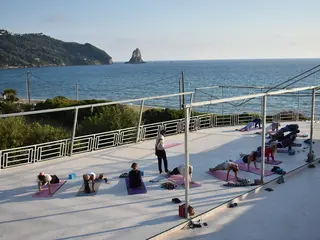
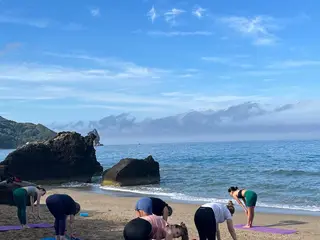
The region you choose shapes a Greek retreat almost more than the style itself. Four landscape spaces have settled into different yoga focuses, and it is worth checking before booking which one fits your practice. Corfu and the Ionian islands stand for a soft, green variant. The vegetation is denser and gentler than on the Cyclades, the air carries more humidity, and the light is filtered through old olive groves. This atmosphere suits hatha, yin and anusara-leaning stays particularly well, as well as programmes with a focus on meditation and nature awareness. Crete is by far the largest island and offers two worlds in one: the calmer western regions around Chania with mountains and gorges, and the warmer, drier southern coastlines between Plakias and Ierapetra. You will often find longer retreats here of ten to fourteen days, frequently rooted in traditional ashtanga or vinyasa lineages, with multi-year teacher-student relationships and a small, year-round scene of their own. The mainland Peloponnese is the right choice if silence, altitude and seclusion are your priority. The region offers mountains, old pilgrim trails and small villages without tourist density. The focus here is often on silent segments, meditation, pranayama and longer walking sessions through the landscape. Chalkidiki in the north — the three peninsulas east of Thessaloniki — combines quiet beaches with dense pine vegetation and feels gentler than the southern islands. It suits yoga-with-wellness stays particularly well, where proximity to the sea, walks and physical recovery frame the programme. If you are looking for a first Greek experience with a short travel time and a high comfort level, this is a good choice.

What a yoga day in Greece looks like

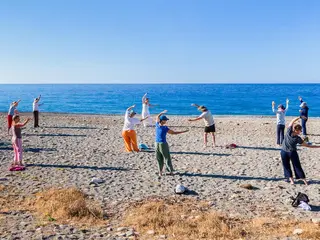
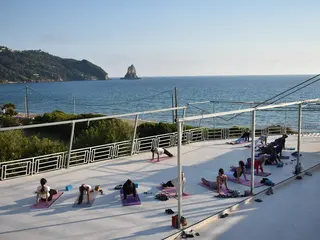
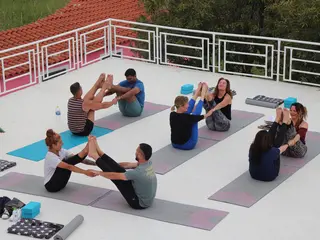
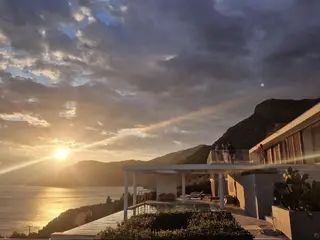
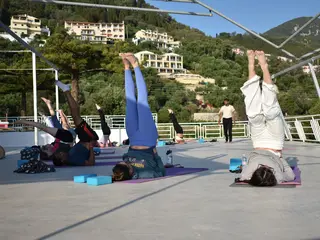
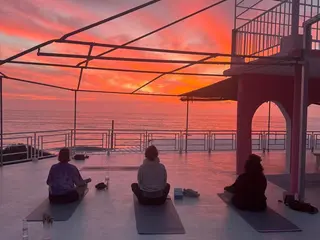
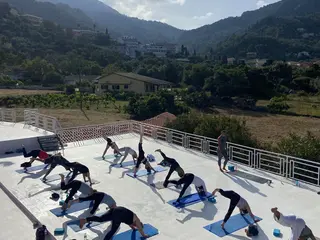
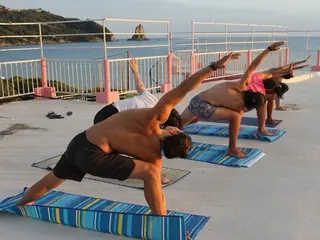
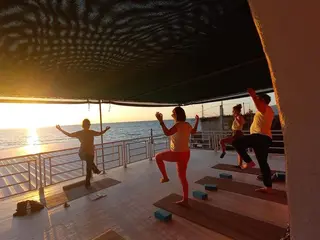
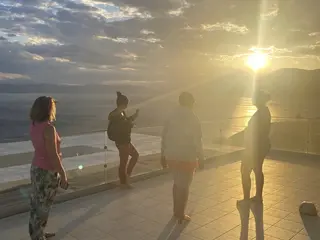
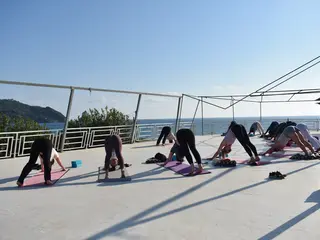
A typical day in a Greek retreat house starts early and ends slowly. Morning practice usually begins between seven and seven-thirty, often on an open platform, in the garden or facing the sea. The air at that hour is cool, the light soft, and the first ninety minutes are usually given to a more active practice: vinyasa, hatha, ashtanga-leaning sequences or strong pranayama. Those looking for something gentler will also find it — most houses offer parallel or alternative tracks. After practice comes a long, shared breakfast. Greek houses pay close attention to seasonal, regional ingredients: fresh fruit, yoghurt with honey, bread, boiled eggs, a selection of salads and spreads. Olive oil is the base of almost every meal — the region produces some of the finest oils of the Mediterranean, and many houses work directly with local producers. The late morning and early afternoon are usually free. That time is deliberately protected because the Greek summer heat enforces a natural midday rhythm. You can read, swim, walk, write, sit by the sea or simply rest. Many houses offer optional workshops in this window: anatomy, philosophy, mantra singing or small deepening sessions. Late afternoon brings the second practice. This is generally softer in design — yin, restorative, a slow hatha sequence or a guided meditation. Some houses combine the evening practice with a walk along the coast, through the olive groves or up to a small viewpoint from which to watch the sunset. Dinner is the second main meal of the day and is classically Mediterranean. Vegetables, pulses, fish, sometimes cheese, bread and olive oil form the base. Vegetarian and vegan options are standard in nearly every yoga house. After dinner the day usually winds down quietly: a conversation in the garden, looking at the stars, going to bed early. The structure repeats itself so consistently that your body finds a recognisable rhythm within two or three days.

When to travel to Greece

Greece has two clearly defined yoga seasons, and your choice of timing changes the experience noticeably. The spring season runs from early May to late June and is considered by many teachers the most beautiful period of the year. The days are long, the air is dry and warm, and daytime temperatures sit between twenty-two and twenty-eight degrees. The sea is around eighteen to twenty degrees in May and reaches a pleasant swimming temperature in June. The hills are still green, the macchia and thyme are in flower, and the islands are quiet because the main holiday season has not yet started. The autumn season from mid-September to mid-October is the second major window. The sea is still warm, often warmer than in June, the heat of high summer has broken, and the air carries that clear, slightly golden light that returning visitors so often describe. This is traditionally when the longer retreats take place, often with a focus on meditation, breath work and more intensive practice. High summer from mid-July to late August is less suited to a pure yoga stay. Temperatures above thirty-two degrees, full houses, higher prices and a generally louder island atmosphere shift the character of the stay. If you have to travel during high summer, choose mountainous regions such as inland Crete or the Peloponnese, where temperatures are typically two to four degrees lower than on the coast. The shoulder season also affects pricing. May and October are considered the most economically attractive windows: flights are cheaper than in July and August, many houses offer early-bird or low-season rates, and the quieter island atmosphere allows retreats to work with smaller groups. If you value a concentrated, intimate practice, you benefit noticeably from this timing.

Frequently asked questions

When is the best time to travel for a yoga retreat in Greece?
The best time to travel to Greece for a yoga retreat is May, June, September and October. In these weeks pleasant weather — twenty-two to twenty-eight degrees during the day, mild evenings, low humidity — combines with quieter islands, clear light and sea temperatures that become suitable for swimming from mid-May. May and June are especially beautiful in terms of landscape: the hills are still green, many wild herbs are in flower and the days are long. September and October are considered the strongest window for deeper practice: the sea is warm, the heat of summer has broken, and houses are usually less busy. July and August are less suitable for a pure yoga stay. Temperatures above thirty-two degrees, high occupancy and a generally louder atmosphere make concentrated practice harder. If you have to travel in this window, choose mountainous regions such as inland Crete or the Peloponnese, where temperatures sit noticeably lower. From November to April yoga stays are much less common. A few houses on Crete and on the mainland run small winter retreats during this period with a focus on yin, restorative and meditation.
Which region or island in Greece fits me?
The region shapes a Greek yoga stay almost more than the style. Four areas are particularly established: Corfu and the Ionian islands offer a soft, green atmosphere with dense vegetation and a milder light — well suited to hatha, yin and meditative stays. Crete brings two worlds in one thanks to its size: quiet mountain regions in the west, warmer southern coasts in the east — an established choice for longer, more traditionally oriented retreats in ashtanga or vinyasa. The mainland Peloponnese suits stays focused on silence, meditation and walking meditation. Mountains, old pilgrim trails and small villages without tourist density define the setting. Chalkidiki in the north — the three peninsulas east of Thessaloniki — combines quiet beaches with pine forests and is a relaxed choice for yoga-with-wellness stays and for a first Greek experience with a short travel time. As a guide: if you want the beach and easy water access, Chalkidiki, the southern coast of Crete or Corfu are good choices. If you want quiet and mountain air, the Peloponnese or inland Crete fits better. If you are planning a more traditionally rooted lineage and a longer stay, Crete is the natural destination.
Which yoga styles are taught in Greece?
The range of yoga styles taught in Greece is broad. The largest group are classic vinyasa- and hatha-oriented retreats. Both adapt well to the Greek daily rhythm — a more active morning practice, a softer evening session — and are accessible for beginners and advanced practitioners alike. A second, more traditional line are ashtanga stays. These are particularly present on Crete, often as longer Mysore retreats of ten to fourteen days with daily self-practice under individual guidance. If you are looking for a more intensive, technically precise practice, you will find a long-established scene here with experienced teachers. Yin, restorative and meditation-oriented stays form the third major line. They are offered especially in spring and autumn and fit well with the Ionian islands and the Peloponnese. Beyond that you will find smaller, more specialised offerings such as Iyengar weeks, yin-yang combinations, yoga-with-hiking or yoga-with-breath-work. Overall the country covers the range you would expect from a major European yoga destination — with a slightly stronger emphasis on longer, deeper stays than in some other Mediterranean places.
What is the best way to travel to Greece?
For most yoga guests the journey is by plane. Three airports cover most retreat destinations: Athens (ATH) as the hub for mainland stays and onward connections to smaller islands, Heraklion (HER) for Crete and Corfu (CFU) for the Ionian islands. From Germany, Austria and Switzerland there are year-round direct flights to Athens and Heraklion, and during the summer season also to Corfu, Chania, Thessaloniki, Rhodes, Mykonos and Santorini. Flight times sit between two and a half and just over three hours. Direct flights are cheaper in spring and autumn than in high season; two to three months of lead time is worth the effort. The transfer from the airport is organised by many houses — either as a group transfer or as an individual shuttle for a fee. For a pure yoga stay in a single house, a rental car is not strictly necessary. One thing to check before booking: some houses on smaller islands can only be reached by domestic flight or ferry from Athens, which adds half a day to a full day to the journey.
What does a yoga retreat in Greece cost?
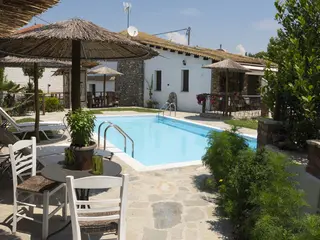
The typical price range for a yoga retreat in Greece runs from around eight hundred euro for a seven-day stay in a simple house with shared rooms up to roughly two thousand five hundred euro for a week in a single room at a higher-end house. Most stays fall between one thousand and one thousand seven hundred euro per week in a double room. Four factors shape the price most strongly: the season, the region, the room category and the programme depth. May, June, September and October are more expensive than the shoulder months of April and November. The Ionian islands and Crete tend to sit slightly higher than mainland destinations on the Peloponnese. Houses with a pool, private beach access or a spa component charge a premium. Longer retreats of ten to fourteen days often work out cheaper per day than pure seven-day stays. What is not included is usually the journey itself, travel insurance, additional massages or one-to-one sessions and optional excursions. When comparing offers it is worth calculating the real daily price including full board and yoga hours, since that gives a more realistic picture than the headline weekly rate.
Are yoga retreats in Greece also suitable for beginners?
Yes. A large share of Greek yoga retreats is explicitly designed for mixed groups and is accessible for beginners. Most houses work with classical hatha or a gentle vinyasa — styles that adapt to different levels of experience. Teachers usually offer several variations of a pose, so first-time practitioners and experienced students can share the same class without anyone feeling left behind. For a genuinely relaxed entry, look for stays with small group sizes (typically six to twelve people), two yoga sessions a day and a clear daily structure. This format makes it easier to settle into practice without feeling overwhelmed. For ashtanga-oriented retreats — especially Mysore formats — an honest self-check is worth the time: these stays usually assume an existing, regular practice and are less suitable for complete beginners. Descriptions using terms such as 'all levels welcome', 'beginner-friendly' or 'open level' signal that the teachers actively work with different backgrounds.
What is usually included in the price of a yoga retreat in Greece?
The price typically includes four components: accommodation, full board, the daily yoga programme and supporting activities such as meditation, breath work or guided walks. Accommodation usually means a room in double or single occupancy. Some houses also offer shared rooms for travellers on a tighter budget. Full board typically consists of three meals a day, vegetarian or vegan, with seasonal regional ingredients. Water, tea and often coffee are included. The yoga programme generally includes two daily practice sessions — a more active morning class and a softer evening session — plus optional workshops. Guided meditation and an introduction to breath work are often part of the programme. Not included are usually the journey itself, insurance, alcoholic drinks, additional massages and optional excursions such as guided hikes or boat trips. For wellness-oriented stays, additional spa treatments may be included or charged separately depending on the house — worth checking specifically before booking.
Why is Greece an ideal destination for a yoga retreat?
Greece combines turquoise seas, sun-kissed islands, and a millennia-old culture of body and mind care. The relaxed way of life, the light, and the landscape create a unique atmosphere for yoga practice. At Retreat Vacation you'll find 25 yoga retreats in Greece.
How much does a yoga retreat in Greece cost?
Yoga retreat prices in Greece range from €450 to €3.250, with an average of €1.425. Greece offers very good value for money compared to other European destinations – especially on the mainland and less touristy islands.
When is the best time for a yoga retreat in Greece?
The best time to visit is from May to October. Spring and autumn offer pleasant temperatures around 25°C – ideal for outdoor yoga. July and August can get very hot, but the sea is perfect for swimming after practice. On Crete, retreats are possible into November.
On which Greek islands are yoga retreats available?
Particularly popular are Crete, Corfu, Lesbos, Paros, Naxos, and the smaller Cycladic islands. Each island has its own character: Crete offers mountains and gorges, Corfu lush greenery and Venetian flair, the Cyclades minimalist island feeling with white houses and blue sea.
Are yoga retreats in Greece available in English?
Most yoga retreats in Greece are conducted in English, making them accessible to an international audience. The multicultural atmosphere is considered enriching by many participants. Filter by course language when searching.
What makes yoga retreats in Greece special?
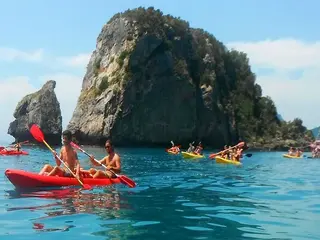
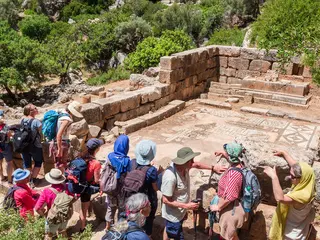
The combination of yoga by the sea, Greek cuisine, and Mediterranean climate is unique. Many retreats take place on terraces with sea views or directly on the beach. Practice is often complemented by swimming, snorkeling, hikes to ancient sites, and fresh local cuisine with olive oil, feta, and fresh vegetables.
How do I get to a yoga retreat in Greece?
The major islands and Athens are reachable by direct flight from Germany in 2.5–3.5 hours. Smaller islands can be reached by domestic flights or ferry. Many retreat organizers help with travel planning and offer transfers from the airport or port.