Pilates vacation February 2026

Pilates is a great change from a regular vacation.
Here are great offers that take place February 2026.
Discover Our Most Popular Offer

View all offers

New retreats straight to your inbox?

So you always stay up to date.

We take data protection very seriously. Further information
What sets a pilates retreat apart from a studio class

What sets a pilates retreat apart from a studio class

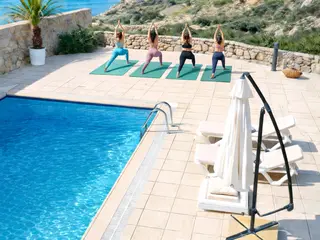
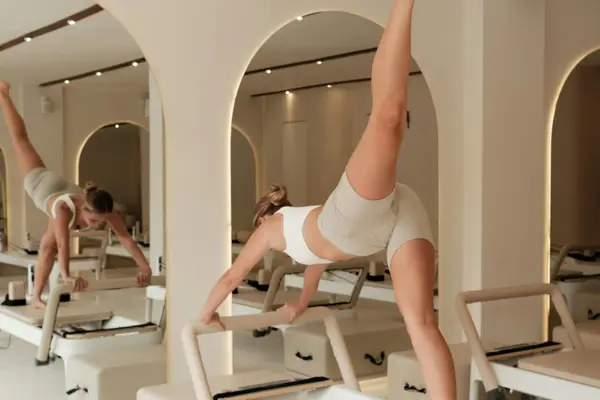
A pilates retreat is not a 60-minute studio class with a hotel attached. It is a continuous break, with pilates carrying the rhythm of the day, usually four to seven days in a quiet setting, two sessions per day, and breaks that matter as much as the practice itself. An alert morning session, a calmer sequence in the afternoon, and hours in between with no schedule pressing. What often still sits in your shoulders an hour after class at home loosens up across the whole day on a retreat, and the steadier posture does not vanish the moment you leave the studio. In the Retreat Urlaub catalogue the programmes run about five days on average, with the typical frame between four days and a full week. Most retreats are set up as group formats for eight to fourteen guests on the mat, a small number of venues add reformer work, a sliding carriage with spring resistance used to train stability and deep musculature with precise load. There are 22 pilates retreats currently bookable. Every programme page shows you the schedule, the trainer, the room type and the meal plan in detail.
What a typical day at a pilates retreat looks like

What a typical day at a pilates retreat looks like

Programmes differ in detail, but the daily frame at most retreat houses follows a similar pattern. Your day starts with a mat-based pilates session, often 60 to 75 minutes, set up calmly and focused on breathing, alignment and the conscious activation of the centre, the deep abdominal and back muscles known in the pilates tradition as the powerhouse. Breakfast follows, often vegetarian or built around fresh, light food. Late morning is often free, frequently used for a walk in the surrounding area. Around the Mühlviertel region in Austria or near the finca venues on Mallorca, that break translates straight into a hike. Around midday or in the early afternoon some programmes schedule an additional unit, for example fascia work to support tissue regeneration or a mindfulness sequence. The late afternoon brings your second pilates session. It tends to be more dynamic than the morning practice and uses wider movement ranges. After dinner the evening is either free or includes one extra element such as a guided meditation or a short stretching sequence to wind down. About half of the programmes in the catalogue include a wellness-oriented element, such as a massage during the stay. Group sizes typically fall between eight and fourteen guests. You will find the exact schedule, the meal plan and the room arrangement listed on each programme page, which lets you set realistic expectations before booking.
Methods and equipment in the catalogue

Methods and equipment in the catalogue

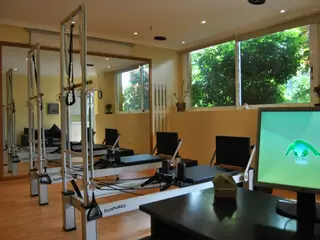
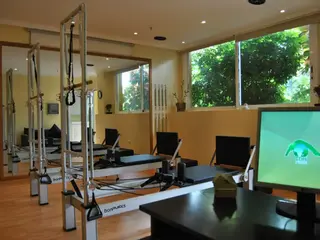
Pilates is taught in different forms, and the programmes in the catalogue reflect that range. The clear focus is mat pilates, the classical form practised on the mat without machinery, where your body weight and controlled movement set the load. This form is the backbone of nearly all programmes, it is straightforward to schedule, group-friendly and adaptable to mixed levels. A small number of venues add machine pilates on the reformer. The reformer is a sliding carriage with springs that create resistance through a moving platform, so stability and deep musculature can be trained with high precision. In the current catalogue this format is offered mainly in one Tenerife-based programme, where reformer and mat sessions are combined. A second strand are programmes that combine pilates with other movement forms. Pilates programmes with complementary yoga sequences are particularly common, about ten of the available programmes integrate such yoga units, often as a gentle morning practice or as a calm element in the evening. Three programmes build meditation into the daily structure, four include hikes or mindful walking as a fixed element. Breathing techniques from the pilates tradition, where focused chest and lateral breathing guides the movement flow, are named explicitly in several programmes. Which method fits you depends on the priority: a deep dive into pure mat-based pilates, pilates practice complemented by yoga or meditation for a broader daily arc, or the rarer, training-heavy variant with reformer sessions.

Frequently asked questions

What is a Pilates retreat?
A Pilates retreat is a multi-day getaway where you can fully focus on Pilates training, body awareness, and relaxation. Away from everyday life, you deepen your Pilates practice under professional guidance, strengthen your core muscles, and find greater balance and well-being. At Retreat Urlaub, you'll currently find 22 Pilates retreats to choose from.
Who are Pilates retreats suitable for?
Pilates retreats are suitable for all experience levels – from complete beginners to advanced practitioners. Most retreats offer different difficulty levels so that each participant is individually challenged and supported. Pilates is particularly gentle on the joints, making it an excellent choice for people with back problems or those returning after an injury break.
How much does a Pilates retreat cost?
Prices for Pilates retreats vary depending on duration, accommodation, and the scope of the program. At Retreat Urlaub, prices range from €530 to €2.700, with an average price of around €1.217. Typically, accommodation, Pilates sessions, and often healthy meals are included in the price.
What is the difference between Pilates and yoga?
Although Pilates and yoga share some similarities, there are key differences. Pilates focuses more on strengthening deep stabilizing muscles, particularly the core and pelvic floor, and often uses specialized equipment like the Reformer. Yoga, on the other hand, places more emphasis on spirituality, meditation, and flexibility. Many retreats also combine both disciplines – browse our 22 offerings to find the perfect retreat for you.
What should I bring to a Pilates retreat?
For a Pilates retreat, we recommend comfortable, form-fitting sportswear that allows freedom of movement, non-slip socks or light athletic shoes, and your own yoga mat if you prefer. However, many retreats provide mats and Pilates equipment on-site. Also remember to bring comfortable casual clothing, a water bottle, and perhaps a notebook to write down exercises and tips.
What are the health benefits of a Pilates retreat?
A Pilates retreat offers numerous health benefits: Through intensive yet joint-friendly training, you strengthen your core, improve your posture and flexibility, and release tension. Regular Pilates can alleviate back pain, improve coordination, and enhance overall body awareness. In the relaxed retreat atmosphere, you also benefit from stress reduction and mental recovery.
What does a typical day at a Pilates retreat look like?
A typical day at a Pilates retreat often starts with a gentle morning session to activate the body, followed by a healthy breakfast. The morning usually features a more intensive Pilates session, while the afternoon is reserved for relaxation, workshops, or complementary activities like hiking, swimming, or massage. You can wind down the evening with a light stretching session or by relaxing with the group.
Can I book a Pilates retreat on my own?
Yes, absolutely! Most Pilates retreats are ideal for solo travelers. You'll meet like-minded people who also want to work on their fitness and well-being, and you'll quickly make new connections in the warm retreat atmosphere. Of course, you can also join with friends or as a couple. Browse through our 22 Pilates retreats and find the offering that's perfect for you.