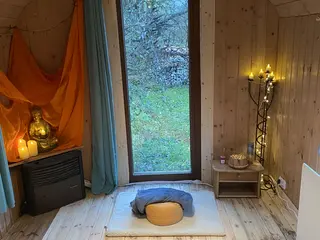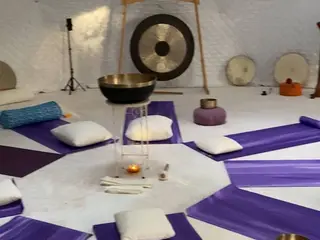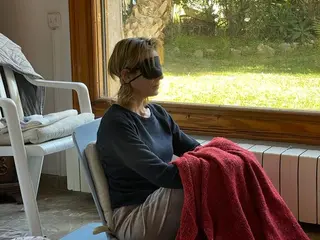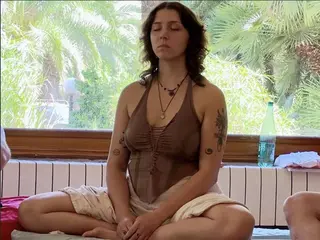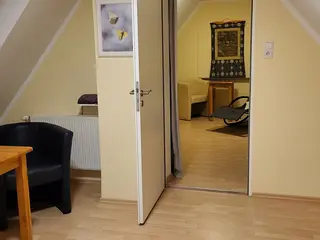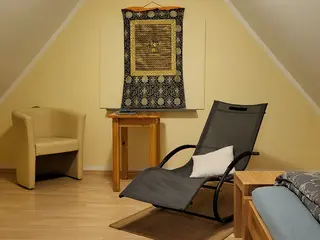
5 People interested InspirAre Solo Retreat: Yin Yoga, Inner Child Work, Conscious Manifestation Optional Soul Coaching Stuckenborstel, Germany $223 / 3 Days 5.0
11 People interested Individual retreat - Your time in essence - with and without mentoring Grebs-Niendorf, Germany $387 / 4 Days 5.0
6 People interested Individual retreat in the hermitage under the cherry tree Damshagen-Stellshagen, Germany $505 / 5 Days 5.0
14 People interested (R)TIME OUT WITH HORSES - self-awareness and "being conscious" Wiesenburg/Mark, Germany $1,046 / 3 Days 5.0
10 People interested TIME FOR YOU: Constellations, self-awareness & coaching with horses Wiesenburg/Mark, Germany $764 / 2 Days 5.0
7 People interested Live in harmony with your soul - 10 days of intensive individual coaching & nature Krakow am See, Germany $2,587 / 10 Days
14 People interested RETREAT: TIME OUT WITH HORSES JUST FOR YOU Wiesenburg/Mark, Germany $1,046 / 3 Days 5.0
15 People interested Vipassana Island I Insight into the nature of all things I Meditation weekend near Cologne Leverkusen, Germany $329 / 3 Days
12 People interested Vipassana Island I Insight into the nature of all things I Meditation weekend near Dénia Dénia, Spain $199 / 3 Days
11 People interested Breathwork and AwarenessWorkshop - In the middle of life - Mondsee, Austria $339 / 2 Days
Silence as practice, not as deprivation Silence sounds like lack, like leaving something out. In practice it is the opposite. Three or more days without speaking do not show their effect immediately. The first 24 to 36 hours are noisy in a different way: the mouth is quiet, but the head still sends. Comments, judgments, plans, worries, the running stream of inner narration that fills the day continues, just unspoken. What shifts after the threshold is not the absence of thought but the volume. Perceptions that the busy mode drowns out come back: the sound of one's own footsteps, wind moving in trees, the taste of a meal eaten without conversation. Practitioners describe it as feeling again instead of only thinking. That experience is the actual reason people book a silent retreat, not the formal absence of speech, but what follows from it. Weekend formats with two hours of silence do not produce this. The mechanism needs duration because the mind takes a day to slow its broadcast. Only after that does the actual reason for coming arrive: a rest deeper than sleep delivers, not because of what is added but because of what stops. That is why most programs at Retreat Urlaub run between three and seven days rather than over an extended weekend. Anyone choosing the shorter formats should know that the first two days function as a runway. The effect arrives afterwards. Longer stays go deeper. The minimum duration is not a marketing argument but a structural condition of the practice.
What a silent day looks like The shape of the day depends on the tradition, but the framework rhymes across most retreats. Five to seven sitting phases spread across the day, each 45 to 90 minutes, with meals taken in silence, walks, or a morning yoga session in between. The day starts early, often between six and seven, and ends before ten in the evening. Secular MBSR programs add body-scans and gentle movement guidance. MBSR stands for Mindfulness-based Stress Reduction, a mindfulness-based program developed by Jon Kabat-Zinn at a US medical center in the late 1970s: clinical in background, not religious. In a yoga-based silent retreat, the morning sits on asana, the physical postures, followed by seated meditation. In Christian silent exercises hosted in monasteries, the day is shaped by the liturgical hours of the host community: Lauds in the morning, Vespers in late afternoon, Compline before night-rest. Silence here is the setting, not the program. Free time fills the gaps between services, with no guided meditation imposed. The real difficulty rarely lies in the sitting phases. It lies in the transitions. In the breaks without a smartphone. In the meals without table talk. In the thirty minutes between sessions where nothing fills the space. That is where the effect practitioners come for actually develops: not inside the formal meditation, but in the gaps between, when the head has no assigned task for the first time in weeks.
Before the first time: what beginners actually experience First-time silent practitioners rarely fear the absence of speech itself. The worry runs underneath and is hard to put into words: what happens when the inner voice is no longer covered by conversation, podcasts and social-media scrolling. Does it grow louder, more critical, harder to live with. In the first 36 hours, a wave of restless thoughts is common: memories surfacing, emotions appearing without obvious cause, sometimes tears. This is not a crisis. The head is discharging what daily life keeps shelved, things that accumulate without ever finding a place to land. Experienced teachers and monastic hosts expect this phase and do not intervene as long as the guest is not actively seeking conversation. This phase usually settles within a day, after which the inner space becomes quieter and more workable. For a first silent retreat, three to five days is a realistic span. This is also the most common format at Retreat Urlaub. Shorter weekend slots exist but rarely reach the critical point, because the first 24 hours are still in the noisy phase exactly when departure is approaching. If you enter a longer program without prior experience, choose one that offers companionship: an MBSR or mindfulness-based retreat with daily check-ins from the teacher, or a monastery house where spiritual accompaniment is available on request. The strict autonomous version with zero check-in is too sharp for a first attempt and produces more drop-outs than breakthroughs.
Three schools, three experiences Silent retreats in German-speaking countries appear mainly in three forms. They sound similar from a distance and feel quite distinct on the ground. MBSR and secular mindfulness retreats. MBSR (see above) is mindfulness-based, with a medical and psychological background, not a religious one. Typical length three to seven days. The day combines body-scans, gentle yoga, sitting meditation and walking meditation. A good fit for beginners and for people coming out of burnout, where structure and guidance matter more than formal silence. The most common form at Retreat Urlaub, often hosted in the Black Forest, the Chiemgau region or the Bavarian Forest. Monastery silence and Christian silent exercises. Three to five days as a guest in a Benedictine or Cistercian community, embedded in the liturgical hours of the host. Silence is the frame, not the program. No method is taught, spiritual accompaniment is available on request. Most monasteries explicitly welcome guests without a church background. St. Ottilien in Bavaria and Huenfeld in Hesse are examples at Retreat Urlaub. Combined retreats with yoga and meditation. Seven to eight days, with silence supported by a daily morning yoga session, followed by seated meditation and unstructured time outdoors. Popular with practitioners who already have yoga experience and choose silence as a deepening step rather than as a first entry point. Which format fits you depends less on worldview and more on how much structure and guidance you need during your first silent experience.