10 People interested Kyuka Surfclub – Dein Premium Surf & Soul Retreat auf Fuerteventura Lajares, Spain $11,503 / 8 Days
What a pottery retreat is built on A pottery retreat combines hands-on craft with a break from the pace of everyday life. The potter's wheel, building with coils, or modelling free forms all require several hours of undisturbed concentration. Short weekends are enough to experience the basics, while multi-day journeys make space to follow several pieces from raw clay to the fired result. The offers in our catalogue cover two clear streams. On one side, there are compact workshops with wheel or hand-building, often designed as an extended weekend, with three to five days of practice and a firing at the end. On the other side stand longer journeys, where pottery is combined with mindfulness, yoga, or a specific region as the leading theme, often across a full week. The same applies to both formats: the groups are small, usually between six and ten people. Materials, kiln, and tools are provided by the studios, while personal brushes or sketches can be brought along. Anyone who wants to take their own finished pieces home stays until the firing is complete. Drying time matters. Fresh clay needs one or two days, depending on wall thickness, before the piece can take its first firing, followed by a second firing with glaze. On shorter weekends the firing continues in the studio after departure, and the finished pieces are shipped to participants by post. On longer retreats, both firings can still be followed during the stay itself.
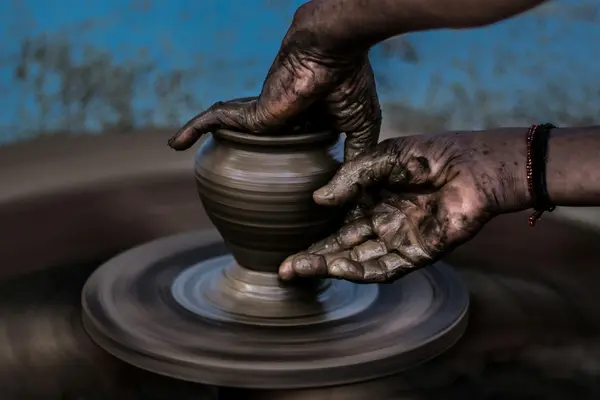
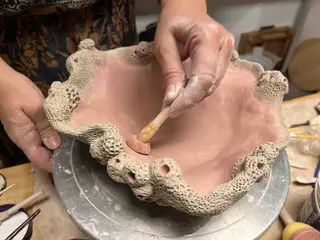
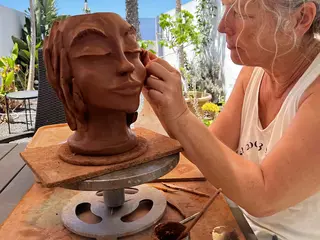
Wheel, hand-building, and free modelling On the potter's wheel, a piece grows from a single lump of clay. Centring is the first step, often the hardest, and it needs repetition. Anyone who sticks with it for three or four days usually reaches the point where a bowl grows reliably under their hands. Stoneware, porcelain, and engobes are the most common materials in the catalogue, each with its own character. Hand-building techniques, working with coils or slabs, need no machine. That makes them ideal for beginners and for retreats where the studio set-up should stay uncomplicated. Bowls, vessels, and sculptures develop at a calmer pace, with more room for adjustments. Free modelling is the focus of programmes with an art-therapy orientation. The point here is less the presentable result than the process itself. The material responds to every movement of the hand, and exactly this dialogue becomes the centre. Which technique leads a retreat is decided less by the location than by the orientation of the teachers. Many retreats deliberately mix the three approaches. A morning at the wheel, an afternoon with hand-building, and on the third day a free modelling session in which the learned moves are applied without a tight brief. This staggering gives beginners the security of having tried each technique at least once, and gives advanced participants the option to work more deeply on a single form across several days.
Pottery as a way of slowing down Anyone working with clay cannot be in a hurry. The wheel forgives no haste, drying takes its own time, firing runs over hours. These built-in pauses are not a weakness of the craft but part of its effect. Many travellers come precisely for that reason: the work itself dials down the personal pace without anyone having to ask. A growing number of programmes in the catalogue frame pottery explicitly as a mindfulness practice. Silent stretches in the morning, short meditations before work begins, or a daily structure that clearly separates practice, walks, and rest. You'll find such formats in Tyrol or the Allgäu, as well as in southern Italy's Cilento region, which brings its own stillness through quiet villages and long hours of light. Most participants arrive without artistic ambition. They are looking for a frame in which the hands stay busy and the mind can quieten. Exactly this is what the material offers. After three days, the focus shifts, breathing becomes slower, and the first usable jug often only appears when it is no longer the actual goal. There is a physical effect that often gets mentioned. Shoulders soften, the gaze grows quieter, sleep becomes deeper from the second night on. Anyone arriving with tension or desk fatigue feels the change especially in the first few days. This is not framed as a therapeutic promise, but rather as a side effect of a practice that demands full attention and, in return, releases inner stress.
Who a pottery retreat is suited for Pottery retreats tend to attract three profiles. First, beginners who have never used a wheel and want to experience how the material behaves over a compact weekend. The two- to three-day intensive formats are designed for them, with the basics introduced step by step. Second, returners who did ceramics during school or studies and want to reconnect after years away. They benefit from the five-day retreats, because only that timeframe lets their own practice resettle. Several pieces often emerge during such a stay, and travel home with them. Third, experienced potters who travel for a specific technique. Porcelain throwing with seasoned studio leads, ceramic surface design with engobes, or Raku-style firing methods are in the catalogue for this group. The demands are higher here, but the results are also more precise. Anyone unsure whether an offer matches their own level can clarify that in advance with the studio. Travellers often come alone. The calm atmosphere and small groups make it easy to arrive without companions and feel part of the studio after a short time. Couples and friend-duos come along as well, and some retreats are explicitly described as a weekend break for two. Family programmes for adults and teenagers are less common, but available, often during the Easter and summer holiday windows.