Yoga Retreat Week at the Ashram – 6 Days of Yoga, Meditation, and Community
Horn-Bad Meinberg, Germany
$345 / 6 Days
4.5A short retreat over the weekend? A Breathwork weekend is great for this. You don't always have two or three weeks to escape everyday life. It's a good idea to take a short break over the weekend to recharge and breathe deeply. With a Breathwork weekend you will start the next week feeling rested!

Horn-Bad Meinberg, Germany
$345 / 6 Days
4.5
Flechtingen, Germany
$365 / 3 Days
5.0
Zahora/ Barbate, Cadiz, Spain
$824 / 7 Days

Lajares, Spain
$10,880 / 8 Days

Ronco, Italy
$4,066 / 6 Days

manacor, Spain
$5,164 / 11 Days

Palma de Mallorca, Spain
$2,143
$1,813
Frühbucher Jan-Mär
/ 5 Days

Manacor, Spain
$3,625 / 8 Days

Feucht, Germany
$648 / 3 Days
5.0
Rt Veslo, Montenegro
$2,143 / 7 Days

Son Servera,, Spain
$1,318 / 3 Days

Son Servera, Spain
$1,648 / 6 Days

Palma de Mallorca, Spain
$1,703
$1,373
Frühbucher Jan-Mär
/ 3 Days

Budens, Portugal
$2,187 / 7 Days

manacor, Spain
$4,385 / 8 Days
Niebüll, Germany
$5,374 / 24 Days
Huéscar, Spain
$5,495 / 7 Days
Son Servera, Spain
$2,967 / 8 Days
Heiligengrabe, Germany
$2,857 / 28 Days

Palma de Mallorca, Spain
$2,307
$1,978
Frühbucher Jan-Mär
/ 5 Days

zahora, Spain
$1,417 / 6 Days

Krong Siem Reap, Cambodia
$1,528 / 4 Days

Palma, Spain
$1,538 / 6 Days

Palma, Spain
$978 / 4 Days
New retreats straight to your inbox?
So you always stay up to date.
We take data protection very seriously. Further information

Breathing work is part of many retreat formats. What makes a dedicated breathwork retreat stand on its own is the depth and intensity of its sessions: instead of ten minutes of breath observation inside a yoga block, the centerpiece is a 45 to 90 minute guided breath journey, usually lying down, with music and one-to-one support. Here, the breath is not preparation for another practice. It is the practice. It carries you through the day.
The difference from pranayama, the breath branch within classical yoga, lies in pace and direction. Pranayama tends to be gentle, regulating and tied to asana. Conscious connected breathwork and comparable methods in our range use an accelerated, continuously linked breathing pattern sustained over longer periods. This briefly shifts blood gas chemistry and is often accompanied by strong physical and emotional phenomena like tingling, warmth or tears.
Layered on top is the retreat frame itself: three to seven days in a small group, with intake conversations, integration breaks, simple food and no phone. This setting is what separates a breathwork retreat from a weekend workshop. If you have already taken breath classes and want to go deeper, the retreat format gives you the time. If you are starting out, the held group structure offers a safe entry, with enough space after intense sessions to settle before the next step. Either way, the format is built around the breath.

The daily rhythm in our range follows a similar shape: around five days, small groups, one major breath session per day plus supporting practice. Mornings often start with gentle movement, a short yoga sequence or a guided meditation. This opens the body without exhausting it and prepares your nervous system for the main session, usually scheduled for late morning or early afternoon.
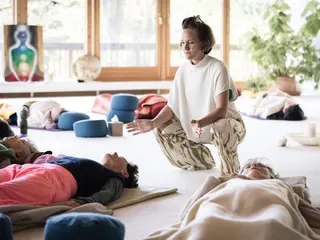
The central breathwork session itself runs between sixty and ninety minutes. You lie on a mat with a blanket, eyes mostly closed. A facilitator sets a breath rhythm and curated music plays in the background. Speaking is not part of this phase. After the session comes an integration window with writing, paired sharing or quiet time in the room.
The afternoon is intentionally softer: a walk, a calm dinner, an evening sharing circle, often closed by a sound bath or a cacao ceremony. These supporting elements appear at a smaller share of the houses and carry the intensity of the morning into the night. You go to sleep early, often before ten.
If you book a weekend format, you receive the core of this structure compressed into two or three days. A full week brings five to six breath sessions plus a fully developed integration arc. In total there are 112 breathwork retreats bookable, with prices between €175 and €11.900 and an average around €1.716, depending on house, region and group size.

Across the retreats listed on retreaturlaub.de, four method clusters appear noticeably more often than others. Conscious connected breathwork, abbreviated CCB, is the named lead method for the intense breath sessions. It refers to a continuously linked, accelerated breath sustained for 45 to 90 minutes, usually performed lying down. Pranayama, the breath branch from yoga, appears in descriptions mainly where the retreat is built as a yoga and breath format combined with asana and meditation. In our range this covers a substantial share of the houses.
A third strand are trauma-release oriented breath retreats, often paired with psychological support or coaching. The focus here is a slow, controlled approach to old body patterns rather than maximum intensity. Such formats appear in our listings several times in North Rhine-Westphalia, Vorarlberg and on Mallorca.
Fourth is the layer of supporting and framing formats: sound baths, cacao ceremonies, shamanically inspired sessions or kundalini yoga with a strong breath emphasis. These do not replace the main session but flank it as openers or closers at the edges of the day.
A note on expectations: holotropic breathwork in the Grof tradition and the Wim Hof method appear in isolated cases but are not focal points of this catalog. Buteyko and rebirthing in their pure forms are barely represented. If you specifically want one of those, check individual listings carefully. The broad middle of our range centres on CCB, yoga-embedded pranayama and trauma-sensitive breath coaching, which is what most German speakers actually find when they book.

A breathwork retreat suits you if you want a clean break after a long stretch of stress, if you feel that talk-only settings have plateaued, or if you are looking for a body-led entry into your own patterns. It also fits you if you already practise yoga and meditation and want to try the next layer of depth. Prior experience is not required, but solid physical stability helps.
The method comes with tangible contraindications that serious providers ask about during intake. With cardiovascular disease, untreated high blood pressure, recent surgery or aneurysm, the accelerated breath pattern is not suitable. With asthma, COPD or other airway conditions, medical clearance is mandatory. Pregnancy normally rules out active, intense sessions, although gentle pranayama work may remain accessible.
Further reasons for careful screening are epilepsy, acute psychiatric diagnoses such as psychosis or bipolar disorder in an unstable phase, and ongoing dissociative symptoms without therapeutic support. If you take antidepressants, benzodiazepines or calming medication, clarify this with your doctor before booking.
A reliable provider runs an intake conversation, explains emergency routines and is willing to decline if needed. If a retreat takes you in without any screening, treat that as a warning sign. When in doubt, a day or weekend format is the better entry than a direct week-long booking abroad. In our range both options are well represented, also in nearby DACH locations, and the booking team is happy to point you toward formats with stronger pre-screening.
FAQ
A breathwork retreat is a guided getaway that focuses on conscious breathing techniques. You'll explore methods such as holotropic breathing, the Wim Hof method, or pranayama to reduce stress, release emotional blockages, and enhance your overall well-being. At Retreat Urlaub, you'll find 112 breathwork retreats to help you discover the transformative power of your breath.
Breathwork retreats are suitable for both beginners and experienced practitioners. No prior experience is needed – most retreats offer compassionate guidance that introduces you to breathing techniques step by step. Whether you want to reduce stress, process emotions, improve your sleep quality, or simply have a deep inner experience, breathwork can be enriching for almost everyone.
Prices for breathwork retreats vary depending on duration, location, and the scope of the program. At Retreat Urlaub, prices range from €175 to €11.900, with an average price of around €1.716. Many retreats include accommodation, meals, and multiple guided breathwork sessions, so you can fully focus on your experience.
Different breathing techniques are taught depending on the retreat. The most common include holotropic breathwork (deep breathing sessions for self-exploration), pranayama (yogic breathing exercises), the Wim Hof method (combining breathing techniques with cold exposure), rebirthing breathwork, and connected breathing. You can find details about the specific methods offered in each retreat description.
Breathwork retreats come in various formats – from intensive weekend retreats (2–3 days) to week-long programs and longer getaways of two weeks or more. Shorter retreats are great for getting started, while longer programs allow for a deeper practice and more lasting transformation. Among our 112 offerings, you're sure to find the right format for you.
We recommend comfortable clothing that allows you to breathe freely, a water bottle, a journal for reflections, and possibly your own yoga mat or blanket. Many retreat organizers provide the necessary equipment, but it's worth checking the specific retreat's packing list beforehand. The most important thing to bring is an open and curious mindset.
Certain intensive breathing techniques may not be suitable for everyone. If you have cardiovascular conditions, epilepsy, are pregnant, have severe mental health conditions, or have had recent surgery, you should consult your doctor beforehand. Most retreat organizers ask about health restrictions in advance and adapt the practice accordingly. Please read the specific notes in each retreat description carefully.
Experiences at a breathwork retreat are very individual. Participants commonly report deep relaxation, emotional release, increased clarity and energy, and a stronger sense of body awareness. Some may experience intense emotional or physical sensations during sessions – this is completely normal and is supported by experienced facilitators. In the long term, regular breathwork can strengthen stress resilience and lead to greater inner calm and balance.