Retreat Urlaub - Urlaubsangebote für Körper, Geist und Seele.

Active Holidays in Portugal

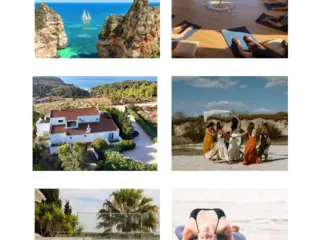
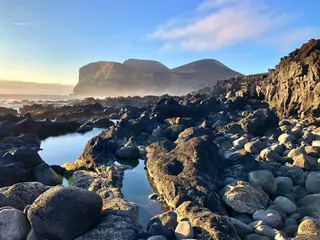
Long Atlantic cliffs along the Algarve and Alentejo coasts, green mountains in the north between the Douro and the Minho, the quiet plateaus of the Beira region and the wild island landscapes of Madeira and the Azores — Portugal is one of the most accessible active-holiday destinations in Europe. From surfing in Ericeira and Sagres through hiking on the Caminhos de Fatima pilgrim trails to yoga stays in the whitewashed villages of Alentejo, movement can be paired with a relaxed, almost meditative Atlantic atmosphere.
7 curated retreats from €690

Discover Our Most Popular Offer

View all offers

New retreats straight to your inbox?

So you always stay up to date.

We take data protection very seriously. Further information
What makes active travel in Portugal distinctive

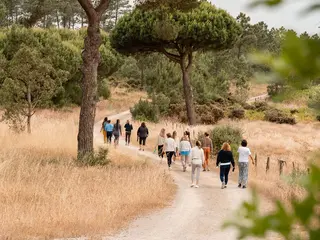
Portugal has become one of Europe's most sought-after active-holiday destinations in the last decade — for three reasons that rarely combine. First, a reliable, mild climate with more than two thousand seven hundred sunshine hours per year and a short winter that allows active programmes to run year-round in most regions. Second, an extremely long, largely unspoilt Atlantic coast — around eight hundred kilometres on the mainland, plus Madeira and the Azores — with countless micro-bays, long coastal trails and some of the best surf conditions in Europe. Third, a calm, friendly daily structure that feels Mediterranean but not as late as Spain — dinner often starts at seven-thirty or eight. The most obvious advantage is the climatic range on a small footprint. In the north — Minho, Douro, Beira — green mountains with a damp, mild climate sit alongside more rain, more forest and denser vegetation. In the south — Alentejo, Algarve — the climate is markedly drier and warmer, with extensive cork oak and olive groves. The Algarve's west coast, with its rough, almost Irish character, differs clearly from the quieter southern coast. The second point is the trail infrastructure along the coast. The Rota Vicentina along the southwest coast is one of the most beautiful long-distance hiking trails in Europe — around four hundred kilometres of marked trails directly along the cliffs, with daily stages of twelve to twenty kilometres, small guesthouses in fishing villages and an atmosphere many hikers describe as spiritual. Alongside it run the Caminho Portugues to Santiago and several shorter stage routes through the country. The third, often underestimated factor is the water-sports tradition. Portugal has the strongest and most consistent Atlantic waves in Europe, which makes it the key destination for surf stays of all levels. Beginner camps on calmer beaches like Castelejo or Praia da Bordeira sit right next to the world-renowned heavy-wave spots at Nazare and Supertubos.

Which outdoor formats the Portuguese regions support

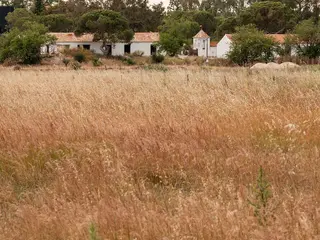
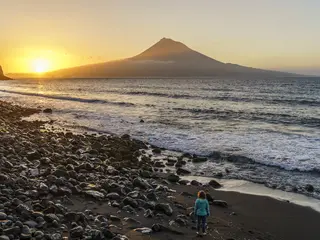
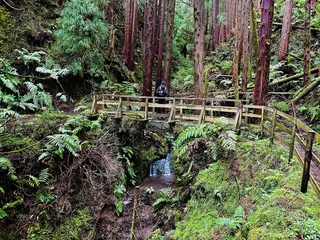
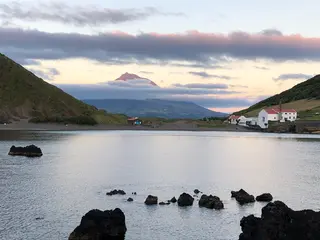
Active holidays in Portugal distribute across four clearly distinguishable landscape spaces, and each carries its own focus. The right path is to choose the landscape first, then the format, and only then the individual house. The Algarve and the southwest coast — the region between Sagres, Lagos, Carrapateira and Odeceixe — carry the strongest surf and hiking formats. The Rota Vicentina lives here, here you find most of Europe's surf beginner camps, here the year-round mild climate carries yoga-hiking stays around the calendar. The eastern Algarve coast around Tavira and Faro is quieter, with long sandy beaches and a more relaxed character. Alentejo — the wide region between Lisbon and the Algarve — carries the quietest, often meditative formats. Cork oak landscapes, wide plateaus, whitewashed villages, very little tourism. Yoga retreats, silent weeks and slow hiking stays find their own kind of stillness here. The Alentejo coast — the northern part of the Rota Vicentina — combines this stillness with Atlantic stages. The Lisbon region and Estremadura — from Sintra through Ericeira to Nazare — carry the second major surf line. Ericeira is one of Europe's few UNESCO World Surfing Reserves and an established surf destination with complete infrastructure. Sintra, with its humid micro-climate and forests, offers a surprising mix of hiking, meditation and nature experiences close to the capital. The north — Douro, Minho, Geres National Park, Serra da Estrela — carries the high-alpine and green mountain formats. The Geres National Park is Portugal's only national park with mountain heights above one thousand metres, dense forest and waterfalls. The Serra da Estrela is Portugal's highest mainland mountain range, reaching almost two thousand metres, with its own hiking and yoga formats. Madeira and the Azores — Portugal's Atlantic islands — form their own league: levada hikes on Madeira, volcanic islands across the Azores, green mountains rising above the ocean.
When to travel for an active holiday in Portugal

Unlike most Mediterranean active destinations, Portugal has a very long active season and only a narrow phase in which certain regions become challenging. The spring season runs from early March to late June and is regarded by many active travellers as the most beautiful window. Wild herbs are in flower, almond and orange blossoms shape the southern landscape, the days lengthen and the weather is dry and mild — daytime temperatures between eighteen and twenty-four degrees. Stages can be walked comfortably, the wind is usually good, the sea is suitable for swimming from May. High summer from mid-July to late August is hotter in the Alentejo and the Algarve, though not as extreme as in Andalusia — temperatures sit between twenty-eight and thirty-four degrees. If you want to travel then, choose the coastal regions where the Atlantic breeze cools the climate. In Sagres, Carrapateira and Ericeira daytime temperatures often sit five to eight degrees below the inland values. Surf stays are particularly popular in this phase — waves are smaller than in winter, but water temperatures are warm and the climate is sunny. The autumn season from September to mid-November is the second major window and is considered by many teachers the ideal yoga-hiking phase. Clear, golden light, the sea is still warm, the heat of summer has broken, and the country starts to recover from the dry summer. Daytime temperatures sit between twenty and twenty-six degrees. This is traditionally when the longer yoga and pilgrim stays take place. The winter phase from mid-November to late February is — unlike in central Europe — its own active season in Portugal. Daytime temperatures in the Algarve and Alentejo sit between fourteen and nineteen degrees, the weather is mild, often sunny, occasionally rainy. Yoga-hiking stays with a focus on stillness, silent segments and slower practice are particularly popular in this phase. Surf stays for advanced surfers are also in season — waves are bigger, though the water is markedly cooler (fourteen to sixteen degrees).

What a typical active day in Portugal looks like

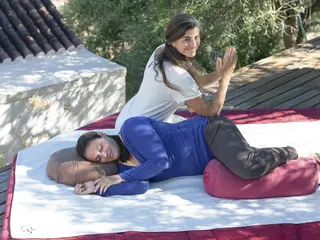
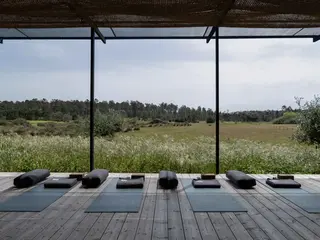
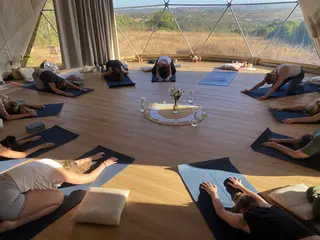
A typical active day in a Portuguese retreat house follows a relaxed, Atlantic-flavoured daily structure. Morning practice usually starts between seven and seven-thirty, often on an open terrace facing the sea or olive groves. The air at that hour is cool and clear, the Atlantic wind often already perceptible. The first sixty to ninety minutes are usually given to an activating practice: hatha, gentle vinyasa, breath work or a short meditation that frames the day. After practice comes a long, shared breakfast. Portuguese active houses pay attention to seasonal, regional ingredients: fresh fruit, bread with olive oil, yoghurt, honey, regional cheese, a warm component. The food culture is friendly, quiet and not as late as in Spain — breakfast often as early as eight, dinner usually around seven-thirty or eight. The main stage of the day starts between half past eight and ten. On hiking stays, it covers a three- to six-hour stage along the coast, through cork oak landscapes or in the mountains of Geres or the Serra da Estrela. On surf stays, this morning belongs to water practice — usually two surf sessions a day, depending on conditions and tides. Yoga-hiking stays combine both or skip the water in favour of longer hiking stages. The early afternoon brings a light lunch and an extended rest period. On the coast this is often the time for a swim in the Atlantic or the pool, a book under a parasol or a short walk. In Alentejo and the inland it is the siesta phase focused on stillness and recovery. Late afternoon holds the second, softer movement session: yin, restorative, a guided meditation or a short breath practice. Some houses combine it with a walk to the coast for sunset — the Atlantic sunset over the water is one of the reasons many guests return to Portugal. Dinner is the second main meal, shaped by regional Portuguese cuisine, often with fish or seafood. After dinner the day winds down quietly.

Frequently asked questions

What does an active holiday in Portugal cost?
The typical price range runs from around six hundred and fifty euro for a seven-day stay in a simple house with shared rooms up to roughly two thousand two hundred euro for a week in a single room at a higher-end house. Most stays fall between nine hundred and fifty and one thousand seven hundred euro per week in a double room. Four factors shape the price: region, season, room category and programme depth. The Algarve and Ericeira tend to sit slightly higher than Alentejo, the Geres National Park or the Serra da Estrela. Surf stays are often cheaper than pure yoga-hiking stays, because surf camps typically work with larger groups. April, May, September and October are more expensive than the shoulder months of February, March and November. What is not included is usually the journey, travel insurance, additional massages and optional excursions. On surf stays, equipment (board, wetsuit) is usually included — on hiking stays, personal hiking gear may need to be brought along. When comparing offers it is worth calculating the real daily price including full board and the movement programme.
When is the best time for an active holiday in Portugal?
The best time to travel for an active holiday in Portugal is April, May, June, September and October. In these weeks pleasant weather — twenty to twenty-six degrees during the day, mild nights, low humidity — combines with long daylight windows and stable trail conditions. April and May are especially beautiful in terms of landscape: wild herbs, almond and orange blossoms shape the atmosphere, the country is green again after winter, the days lengthen. September and October are considered the strongest window for deeper stays — the sea is still warm, the heat has broken, the light is clear and golden. July and August are hotter in Alentejo and the inland, while the coast remains bearable thanks to the Atlantic breeze. Surf stays are particularly popular in this phase. Yoga-hiking stays often shift into the cooler evening hours. November to March is the off-season in many regions — but the Algarve and Alentejo, as one of the few European destinations, carry active programmes year-round. Daytime temperatures between fourteen and nineteen degrees, mild, often sunny climate. Yoga silent weeks, hiking-with-mindfulness and surf stays for advanced surfers are a quiet, undisturbed alternative to central European winter days in this phase.
Which activities are especially popular in Portugal?
Surfing is the most internationally known form of movement in the Portuguese active-holiday landscape. Beginner surf camps on the beaches around Sagres, Carrapateira, Ericeira and Peniche form their own focus — Portugal is one of Europe's most important destinations for first-time surfers. Advanced surfers find some of Europe's strongest waves at Nazare, Supertubos (Peniche) and Praia do Norte. Hiking is the second major form. The Rota Vicentina along the southwest coast, the levada hikes on Madeira, the Geres National Park in the north and the volcanic hikes on the Azores form the most important hiking regions. Yoga-hiking stays usually combine daily hiking stages with yoga in the morning and evening. Yoga retreats are the third line. Particularly in Alentejo, on the Algarve's west coast and in the region around Ericeira, yoga houses have established themselves, working with hatha, vinyasa, yin and breath work. Silent weeks find their niche in the quieter micro-regions of Alentejo. Cycling tours, stand-up paddling, kayaking along the south coast, pilgrimage hiking on the Caminho Portugues and horse-based active holidays in Alentejo complete the picture.
What is the best way to travel to Portugal?
For most active guests the journey is by plane. Four airports cover most active destinations: Lisbon (LIS) as the central hub for Alentejo, Ericeira and the north, Faro (FAO) for the Algarve, Porto (OPO) for Geres and the Douro, and Funchal (FNC) for Madeira. The Azores are reached via Ponta Delgada (PDL). From Germany, Austria and Switzerland there are year-round direct flights to Lisbon, Faro and Porto. Flight times sit between two and a half and just over three hours. Madeira and the Azores are usually reached via Lisbon — short domestic flights connect from there. The transfer from the airport is organised by many active houses — either as a group transfer or as an individual shuttle for a fee. For stays in Alentejo or the Geres National Park a rental car is often sensible, because the final leg via public transport can be long. For pure surf or yoga stays in a single house on the Algarve or in Ericeira, it is usually not strictly necessary. One thing to check before booking: some surf camps have a fixed arrival day (usually Sunday or Saturday) — out- and return flights should align with this.
What is usually included in the price?
The price usually includes four components: accommodation, full board, the movement programme (surfing, hiking, yoga or a combination) and supporting activities such as meditation, breath work or guided walks. Accommodation usually means a room in double or single occupancy. Some houses, especially surf camps, also offer shared rooms for travellers on a tighter budget. Full board typically consists of three meals a day, vegetarian or vegan, with seasonal regional ingredients. Water, tea and often coffee are included. The movement programme usually includes one guided main stage per day plus a softer morning or evening session. On surf stays, surf equipment (board, wetsuit), surf teachers and theory classes are usually included. Guided meditation and an introduction to breath work are often part of the programme. Not included are usually the journey, travel insurance, alcoholic drinks, additional massages and optional excursions (such as boat tours or whale watching on the Azores). For wellness-oriented stays, spa components may be included or charged separately depending on the house.
Are active holidays in Portugal also suitable for beginners?
Yes — Portugal is in fact one of Europe's most accessible destinations for beginners. The surf camps on the Algarve and in Ericeira are explicitly designed for first-time surfers: small groups, calm shorebreaks, plenty of equipment and safety briefing, several week formats per season. For yoga-hiking stays: a large share is explicitly designed for mixed groups and accessible for beginners. The stages along the Rota Vicentina are clearly tiered — a moderate main route with a shorter variant. Daily stages of three to five hours are standard. For pilgrimage walks on the Caminho Portugues — from Lisbon or Porto to Santiago — there are both long full stages over weeks and shorter stage weeks that cover only individual sections. The latter are accessible for beginners. For mountain stays on Madeira (levada hikes) the paths are mostly level — daily stretches are scenically demanding but technically accessible. On the Azores and in the Serra da Estrela the stages are more demanding; an honest self-check is worth the time. Descriptions using terms such as 'all levels', 'beginner-friendly' or 'gentle' signal that the teachers work with different backgrounds.
Which region in Portugal fits me?
If surf, long Atlantic stages and a relaxed, young atmosphere matter to you: the western Algarve coast (Sagres, Lagos, Carrapateira, Aljezur) and the region around Ericeira on the central coast. Expect long sunny weather, mild wind, many surf camps and a surprisingly international scene. If you are looking for silence, a wide landscape and a meditative character: Alentejo. The wide region between Lisbon and the Algarve carries the country's quietest yoga retreats, along with silent weeks and slow hiking stays. Expect very little tourism, wide plateaus, whitewashed villages and a very distinctive atmosphere. If you are looking for mountains, forest and green landscape: the north — Geres National Park, Serra da Estrela, Douro Valley. The more demanding mountain stages live here, with altitudes up to almost two thousand metres, cooler climate and a very secluded atmosphere. If you are looking for island character, volcanic landscape and levadas: Madeira and the Azores. Both island groups carry their own active world — levada hikes on Madeira (long, almost level paths along historic water channels), whale watching and volcanic hikes across the Azores. Madeira has a milder climate, the Azores are damper and greener. For a first Portugal stay with moderate demands and good connections, the Algarve or Ericeira is the most accessible choice.