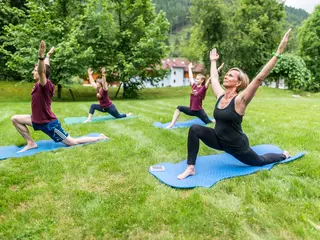


Resilience training February 2026

Resilience training is a great change from a regular vacation.
Here are great offers that take place February 2026.
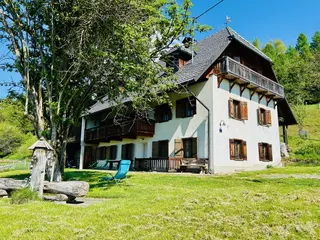
28 curated retreats 5.0 (14 reviews) from €160

Discover Our Most Popular Offer

View all offers

New retreats straight to your inbox?

So you always stay up to date.

We take data protection very seriously. Further information

Frequently asked questions

What is a resilience training retreat?
A resilience training retreat is a dedicated time-out designed to help you strengthen your inner resilience and cope better with stress, crises, and life's challenges. In a safe and supportive environment, you'll learn techniques from areas such as mindfulness, stress management, coaching, and body work that help you navigate everyday life with more emotional stability and composure. At Retreat Urlaub, you'll currently find 108 resilience training offerings.
What is the difference between resilience training and MBSR?
MBSR stands for mindfulness-based stress reduction, an eight-week method developed and clinically evaluated by Jon Kabat-Zinn from the 1970s onwards. It is a form of resilience training, but not the only one. Resilience training is the broader term and includes, besides MBSR, yoga-based stress management, coaching-led weeks, cognitive-behavioural building blocks and combined programs of mindfulness and body work. Anyone looking for a scientifically evaluated method with clear modules chooses MBSR. Anyone wanting a more open, individually reflective approach is better served by a general resilience retreat. The catalogue currently lists 108 programs, ranging from strict MBSR through coaching weeks to yoga-led stress regulation.
Who is a resilience training retreat suitable for?
Resilience training retreats are suitable for anyone who wants more inner strength and composure – whether you're going through a stressful phase in life, want to prevent burnout, or are simply looking for tools to become more resilient. Prior experience is usually not required. These retreats cater to individuals as well as leaders and teams who want to build their resilience in a targeted way.
How long should a resilience retreat last?
An effective resilience week typically lasts five to seven days. Three days are enough for an initial impulse and serve well as a weekend format to learn the method. The full effect, however, only develops once the body has had time to switch into recovery mode, which usually takes two to three days. Longer formats of ten to fourteen days, often as MBSR intensives or sabbatical formats, make sense for deep exhaustion or burnout aftercare. Across all 108 resilience programs in the catalogue, the range runs from weekend workshops to two-week intensives, with five to seven days as the centre, and prices currently between €98 and €6.170, averaging €1.121.
How much does a resilience training retreat cost?
Prices for resilience training retreats vary depending on duration, location, and the scope of the program. At Retreat Urlaub, prices range from €98 to €6.170, with an average price of €1.121. In most cases, accommodation, meals, and the full training program are already included in the price.
Who is resilience training suitable for?
Resilience training is not only for people with a burnout diagnosis. It fits three main groups. First, working people in dense life phases who want to work preventively before exhaustion becomes chronic. Second, people in transitional phases such as a career change, separation, retirement or sabbatical, who are looking for clarity and new routines. Third, people with concrete stress symptoms such as sleep disturbances, constant tension or early exhaustion. For diagnosed mental illness such as severe depression or anxiety disorder, a retreat is a complement, not a replacement for therapeutic support. The catalogue currently lists 108 resilience programs, many with a clear indication description in the house profile.
What methods are used in a resilience training retreat?
The methods vary by retreat but often include a combination of mindfulness exercises and meditation, cognitive behavioral techniques, yoga and body work, breathing and relaxation techniques, individual and group coaching, and nature experiences. Many retreats also integrate evidence-based approaches from positive psychology and resilience research, so you can take practical strategies home with you.
What does a typical resilience retreat contain?
Most programs combine body work, cognitive modules and mindfulness practice. Typical building blocks are breathwork, body scan, sitting meditation, light morning yoga or pilates, reflective writing, group dialogue and one-to-one coaching. Some programs integrate time in nature as a main component, with daily hikes or forest walks. Others lean more towards sound work, yoga nidra or silent meditation. The daily structure tends to be similar: morning body practice, a theoretical or reflective block, free time in the afternoon, an evening gathering. Across the 108 programs in the catalogue, the emphasis varies while the overall build stays comparable.
How long does a resilience training retreat usually last?
The duration of a resilience training retreat typically ranges from an intensive weekend (2–3 days) to one-week or even two-week programs. Shorter retreats are great as an introduction or refresher, while longer stays allow for a deeper exploration of the topics and a more lasting integration of the techniques you've learned. Browse our 108 offerings to find the right duration for you.
How much does a resilience retreat cost?
A five- to seven-day resilience week in the German-speaking area typically costs between 900 and 1,800 euro, depending on room category, board and the scope of individual coaching. MBSR weeks with a certified lead often sit in the upper range, because the method requires lengthier training of the lead. Weekend formats start around 300 to 500 euro, premium coaching weeks on Mallorca or in Tuscany with individual support can exceed 2,500 euro. Across all 108 programs in the catalogue, the range runs from €98 to €6.170, averaging €1.121. Some costs can be partly invoiced as further training or via corporate health programs, depending on the provider.
What are the benefits of a resilience training retreat compared to a regular seminar?
Unlike a conventional seminar, a retreat offers the advantage of completely stepping away from your daily routine. You're in an inspiring environment, free from everyday distractions, and can fully focus on your personal development. The combination of knowledge transfer, practical exercises, nature experiences, and community ensures that what you learn is more deeply anchored, allowing you to return to your daily life feeling stronger and more resourceful.
Do I need prior experience with meditation or yoga?
No. Most resilience retreats are designed for beginners. Guidance and build-up are chosen so that people with no prior experience of breathwork, body scan or yoga can take part. The lead introduces the methods in small steps, often with a theoretical introduction on day one. Anyone with existing yoga or meditation experience gains depth but is not structurally at an advantage. More important than prior experience is the willingness to spend a week working on your own stress pattern. Across the 108 programs in the catalogue, most are marked as beginner-friendly. A few advanced MBSR-intensive formats require an initial eight-week MBSR course, which is explicitly stated in the description.
Can I apply the resilience techniques I learn in my everyday life?
Absolutely! That's exactly the goal of a resilience training retreat. The methods taught – such as mindfulness exercises, stress management strategies, and mental techniques – are designed so that you can easily integrate them into your professional and personal daily life. Many retreats also provide accompanying materials, practice plans, or follow-up sessions to help you maintain the positive effects in the long term.
How do I find the right resilience training retreat for me?
At Retreat Urlaub, you can choose from 108 resilience training offerings. When making your selection, consider the methods used, the qualifications of the trainers, the location, duration, and price range – prices range from €98 to €6.170. Think about your personal goal beforehand: Do you want to prevent burnout, regain strength after a crisis, or generally build your resilience? This will help you find the retreat that best suits your needs.