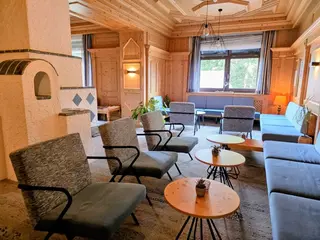

13 People interested Monastery Retreat: Mind Detox with Qigong, Mindfulness, Meditation & Hiking (with health insurance coverage) Kall, Germany $557 / 6 Days
13 People interested Monastery Retreat: Soul & Relax Yin Yoga, Meditation – Mind Detox – (Health insurance coverage available) Kall, Germany $281 / 3 Days
8 People interested ALM RETREAT (4-day mountain getaway for more balance and serenity) Weerberg, Austria $879 / 4 Days 5.0
6 People interested Time for me! - Mindfulness week on La Gomera - "The journey to yourself!" 2 places available!!! San Sebastian, La Gomera, Kanarische Inseln, Spain $818 / 8 Days 5.0
4 People interested LIVE YOUR S.E.L.F. Special: 2-Week Psychological Retreat with Coaching, Breathwork, and Yoga in Bali Bondalem, Indonesia $5,728 / 14 Days
7 People interested 3 days just for me! – Recharging my batteries at the monastery Wald-Michelbach, Germany $407 / 3 Days 4.9
14 People interested Consciousness development in the monastery Siedelsbrunn, Germany $407 / 3 Days 5.0
14 People interested 5 days of coaching and relaxation at Finca Limoncello, Sant Juan, Mallorca Sant Joan, Spain $933 / 6 Days 5.0
13 People interested Time Out: Let Go. Take a Deep Breath. Find Your Center with Somayoga, Sound, Breath, and Meditation Dornbirn, Austria $704 / 4 Days 4.9
5 People interested Intensive week: feel your health holistically Altenfelden, Austria $1,983 / 8 Days
6 People interested Time for me! - "Spirit-free summer time-out" at the OAZE "A journey to yourself." Nagytevel, Hungary $759 / 7 Days
11 People interested LIVE YOUR S.E.L.F. - DEEP INSIGHT: Psychological Retreat with Coaching, Breathwork, and Yoga in Morocco Lalla Takerkoust, Morocco $2,922 / 8 Days 5.0
6 People interested KRAFT-QUELLE-NATUR as a weekend retreat in a monastery—the path to yourself! Wald-Michelbach, Germany $363 / 3 Days
6 People interested Meditative self-reflection at the Bavarian Forest National Park St. Oswald Riedlhütte, Germany $1,702 / 8 Days 5.0
8 People interested LIVE YOUR S.E.L.F. - Psychological Intensive Retreat incl. Yoga, Breathwork & Ceremonies in Bali Tejakula / Singaraja, Indonesia $3,380 / 8 Days 5.0
8 People interested Nature Coaching Retreat – A personalized getaway with lasting effects! JUST FOR YOU! Mühltal, Germany $873 / 2 Days
10 People interested Mindfulness for stress management in a Buddhist monastery Wald-Michelbach, Germany $528 / 5 Days 5.0
7 People interested 3 days - Yoga therapy retreat to strengthen the immune system and resilience Sachsenheim, Germany $346 / 3 Days 5.0
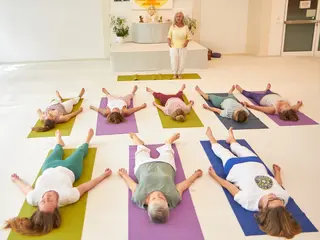
14 People interested Reset & Rise: 7 Days in Mallorca—When High Performance Stops Feeling Good Porreres, Spain $4,096 / 8 Days
4 People interested Find peace and recharge your batteries—your yoga retreat in the Rhön (Bonifatiuskloster, Hünfeld) Hünfeld, Germany $261 / 3 Days
10 People interested 3.5-day intensive goldsmithing / silversmithing course in Tuscany, accommodation possible on site Aulla, Italy $539 / 4 Days 5.0
13 People interested Retreat & Workshop: Activating the "I AM" Energy Field Through the Primordial Structure—Live Your Truth Dornbirn, Austria $610 / 3 Days

What resilience training actually does Resilience is the psychological capacity that allows people to process strain without breaking under it long-term. It has been described in developmental psychology since the 1970s and is now an established part of stress research, burnout prevention and occupational health. Resilience training in a retreat format means practising this capacity over a week instead of merely learning about it in a seminar room. Most programs work with three building blocks. First, body work: yoga, light movement, breathwork and good sleep hygiene. Second, cognitive modules: reflection, writing, group dialogue or one-to-one coaching. Third, mindfulness as the connecting line, often in the MBSR tradition after Jon Kabat-Zinn, an eight-week method that can be practised in compact week-long formats. MBSR stands for mindfulness-based stress reduction. The difference from a classic wellness holiday is the guidance. Resilience training has a clear daily structure, an experienced lead and usually a small group of eight to fifteen people. It is not about spa pampering but about new patterns in dealing with stress, sleep, recovery and self-care. Many participants arrive after an intense professional phase, after exhaustion or with the wish to work preventively before things turn critical.
Which formats exist and who they suit Programs in the resilience field fall into three clear lines. MBSR weeks are the most structured variant, built around breath awareness, body scan, sitting meditation and walking meditation. They follow a scientifically evaluated method and are particularly useful when someone already has a diagnostic background such as sleep problems, chronic stress or early burnout. The second line consists of coaching weeks with one-to-one sessions, group meetings and reflective work. Here a meditation practice is less central than self-inquiry, values work and concrete strategies for daily life. These formats fit when the resilience question is tied to a life situation such as a career shift, a separation or a sabbatical. The third line is yoga- and movement-led resilience weeks, where practice itself is the main route. Pranayama as breath training, gentle hatha yoga, yoga nidra as deep relaxation and sound work in the evenings. The assumption here is that anyone who regularly regulates body and breath builds resilience from the bodily side, without cognitive self-inquiry taking the lead. Which line fits depends most on whether you currently want to reflect, practise or simply down-regulate.
Why resilience works differently in a retreat than at home Shifting the work into a retreat setting is not only geography. It creates the distance from everyday life that makes resilience training possible in the first place. At home, email traffic, family, appointments and obligations are always a click away, and the nervous system stays in a low-level constant alert. In a resilience week this background noise falls away. The first two or three days usually pass with tiredness, because the body is finally allowed to act out the exhaustion it had been holding back. Then something sets in that stress research describes as the parasympathetic mode. Digestion improves, sleep deepens, mood becomes less reactive. On this foundation the cognitive or mindfulness-based modules can actually take hold. Anyone trying to practise resilience on the side, during a lunch break, often ends up frustrated: the method works, the context does not. A good resilience holiday extends exactly this phase into everyday life. The last two days of a week are usually spent translating what was learned into concrete daily micro-practices, ten minutes of breath in the morning, five minutes of body scan in the evening, a writing routine, clear sleep times. Three to five such micro-anchors tend to carry the effect for four to eight weeks, after which a refresher makes sense.
What to watch when choosing a resilience retreat Four criteria help in choosing a suitable resilience format. First, the qualification of the lead. A serious resilience week is led by people with a psychological, psychotherapeutic or MBSR-certified background, not by general wellness staff. Asking about training and years of experience is fair. Second, the group size. Resilience work runs best in small groups, around eight to fifteen people. Larger groups prevent the depth that builds in shared reflection. Very small groups under six are sometimes sold as an advantage but can feel unexpectedly intense for participants who tend to be quiet. Third, the actual daily structure. Ask to see the weekly plan. A good week has clear times for practice, free time, meals and rest. If the daily plan is vague or made of optional modules only, the resilience line is weak. Fourth, the after-care. Good programs offer one to three online sessions in the weeks after the retreat, because it is precisely that phase that decides whether the work transfers into everyday life.